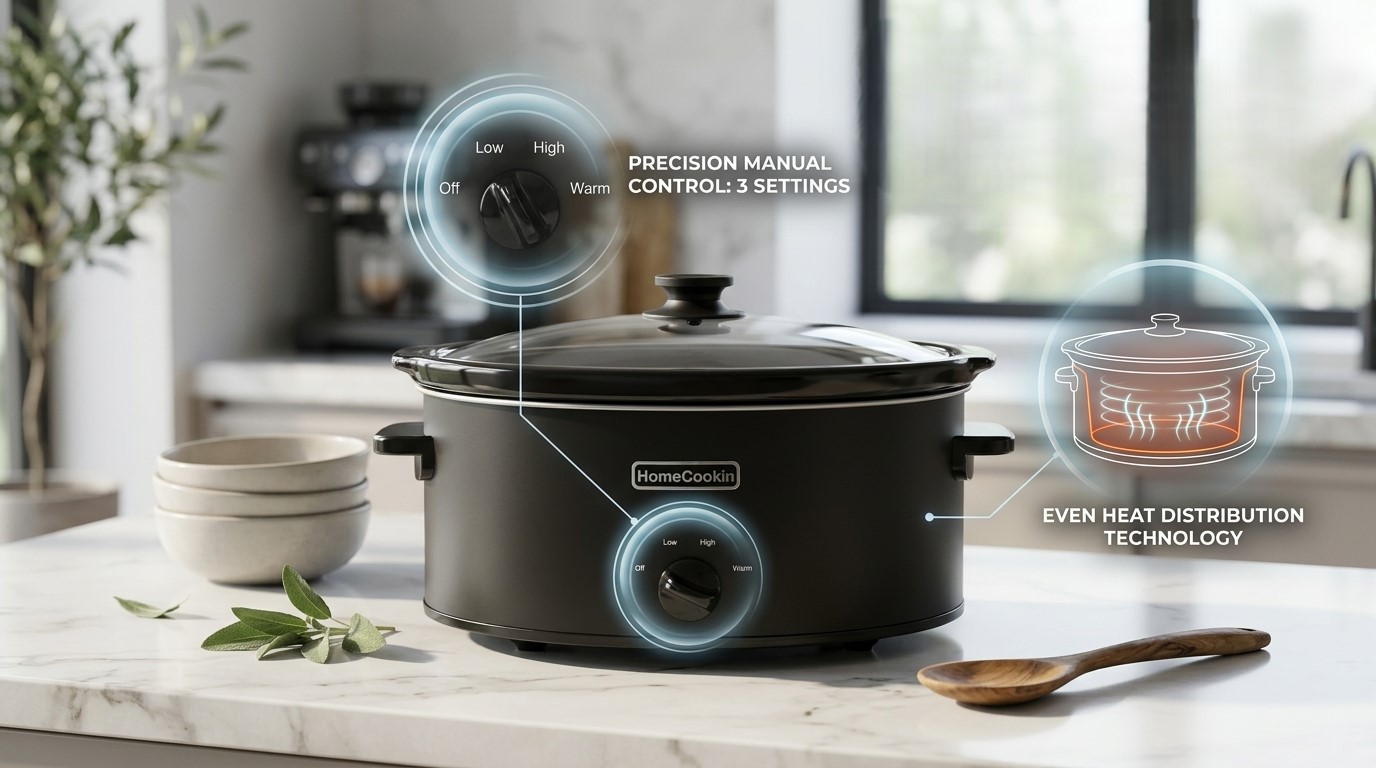
Slow cooking has quietly become one of the most useful habits a home cook can pick up. It doesn’t require constant attention, it forgives a busy schedule, and it turns inexpensive cuts of meat into something worth sitting down for. Among the many manual slow cookers currently on the market, the HOMECOOKIN 6 Quart Slow Cooker in Oval Manual Pot with 3 Cooking Settings and a black stainless steel finish is one option that shows up frequently when people search for a straightforward, no-frills countertop appliance.
This article walks through what the product offers, how it might fit into different kitchens and lifestyles, and what to think about before adding it to your countertop lineup. Rather than framing this as a review, the goal here is to give you the kind of background information that helps you decide whether a manual slow cooker like this one lines up with how you actually cook.
Key Features at a Glance
Before getting into use cases, it helps to understand what this appliance is built around. Based on the manufacturer’s listed specifications, here’s a breakdown of what the HOMECOOKIN slow cooker includes.
6-Quart Oval Capacity
The oval-shaped 6-quart crock is sized to accommodate larger cuts of meat, including whole chickens, pork shoulders, or a stacked batch of ribs, in addition to soups, stews, and grain-based dishes. A capacity in this range is generally described by manufacturers as suitable for feeding a household of roughly eight people, which puts it in a reasonable middle ground: large enough for family meals or a modest gathering, but not so oversized that it becomes awkward to store between uses.
Three Manual Cooking Settings
Rather than digital programming, this model uses a simple dial or switch with three settings: Low, High, and Keep Warm. This kind of manual control appeals to people who prefer a tactile interface over a touchscreen or button panel. You choose your setting based on how much time you have and what you’re cooking, and the Keep Warm function lets the appliance hold food at a safe serving temperature once cooking finishes, which is useful if mealtime doesn’t happen right on schedule.
Stainless Steel Exterior
The black stainless steel shell is designed to resist fingerprints and everyday marks better than a glossy plastic housing might, while also giving the appliance a look that tends to blend in with other stainless kitchen tools. Stainless steel exteriors are also generally easier to wipe down after use, since spills and splatters don’t cling the way they can to matte or textured plastic finishes.
Cool-Touch Handles
Because a slow cooker’s crock gets hot enough to cause burns, cool-touch handles are a practical safety feature rather than a decorative one. These handles are built into the sides of the base and lid so the unit can be moved or the lid can be lifted without needing oven mitts, which matters when you’re transporting a full pot of hot food across the kitchen or to a table.
Tempered Glass Lid
A tempered glass lid allows you to check on food as it cooks without releasing heat and moisture by lifting the lid. This is a small feature, but it has a real effect on cooking consistency, since slow cooker recipes often rely on trapped steam to keep meat tender and prevent liquid from evaporating too quickly.
Removable, Dishwasher-Safe Components
The ceramic insert and glass lid are described as dishwasher safe, which simplifies cleanup considerably compared to slow cookers with a fixed, non-removable pot. The stainless steel heating base, which houses the electrical components, is not submersible and is meant to be wiped down with a damp cloth instead.
How It Can Be Used
A manual slow cooker like this one tends to be more versatile than its simple control panel might suggest. Here are some of the ways it’s typically used in a home kitchen.
Weeknight meal prep. One of the most common uses for a slow cooker is starting a meal in the morning and coming home to something already finished. Because the settings are manual, you’re generally choosing between a shorter High-heat window (often in the four-to-six-hour range) or a longer Low-heat stretch that can run closer to eight hours, depending on the recipe. This flexibility is part of why slow cookers remain popular for people balancing a job with cooking responsibilities.
Batch cooking and meal planning. The 6-quart capacity lends itself well to cooking in bulk. A pot of chili, a batch of pulled pork, or a large tray of baked beans can be portioned out and refrigerated or frozen for the week ahead, which cuts down on the number of nights you need to cook from scratch.
Entertaining and potlucks. Because the Keep Warm setting holds food at serving temperature, this type of slow cooker is also commonly used for gatherings. Dips, meatballs, pulled meats for sliders, or a pot of soup can be kept warm on a buffet table for a few hours without drying out or needing to be reheated.
Braising and slow-roasting. The oval shape is particularly suited to cuts of meat that don’t fit neatly into a round pot, such as roasts, whole poultry, or racks of ribs. Slow, low-temperature cooking is a classic method for breaking down tougher, less expensive cuts of meat into something tender, and an appliance like this is built with exactly that kind of cooking in mind.
Soups, stews, and grain dishes. Beyond meat-centric meals, manual slow cookers are frequently used for vegetable soups, bean-based stews, oatmeal, and rice or grain dishes that benefit from long, even heat. Some home cooks also use them for simple applesauce or fruit compotes.
It’s worth noting that a manual slow cooker like this one does not include digital programming, a delay-start timer, or an automatic shutoff tied to a countdown clock. If you’re used to a programmable model, this is a meaningful difference in day-to-day use, and it’s covered in more detail in the “Important Things to Consider” section below.

Who It May Be Suitable For
Not every kitchen tool fits every cook, so it helps to think through who tends to get the most out of a manual slow cooker in this size and style.
Households that cook for four or more people regularly. The 6-quart size is generally geared toward families or anyone who frequently cooks in larger batches, whether that’s for a household with several people or for someone who likes having leftovers on hand.
People who prefer simple controls over digital interfaces. Some cooks find manual dials more intuitive than digital touch panels, particularly for an appliance that doesn’t need much beyond “on,” “low,” “high,” and “keep warm.” If you find yourself annoyed by having to reprogram a digital timer every time the power blinks, a manual model sidesteps that issue entirely.
Cooks who are newer to slow cooking. Because there’s no programming involved, this style of slow cooker can be a low-pressure way to get comfortable with the basics of slow cooking, such as understanding how Low and High settings differ and getting a feel for cook times with different recipes.
People who host casual gatherings. The combination of a large oval crock and a Keep Warm function makes this type of appliance a reasonable fit for potlucks, holiday side dishes, or any event where food needs to stay warm for an extended stretch without a host having to babysit it.
Anyone replacing an aging or malfunctioning slow cooker. If your current slow cooker’s crock has cracked, the dial no longer clicks reliably, or the lid doesn’t seal well anymore, a straightforward manual replacement in a similar capacity can be an easy, low-learning-curve swap.
On the other hand, this may be less suited to individuals or couples who cook smaller portions regularly and would rather not deal with the counter space a 6-quart appliance requires, or to people who specifically want programmable features like a scheduled start time.
Important Things to Consider
No appliance is a universal fit, and a few practical points are worth thinking through before deciding whether this model matches your needs.
Manual vs. Programmable Operation
Because this is a manual slow cooker, it doesn’t include a built-in timer that automatically switches from cooking to Keep Warm after a set number of hours. That means if you’re heading out for the day, you’ll want to have a realistic sense of your recipe’s total cook time, or you’ll need to rely on a separate plug-in timer if you want that kind of automation. For some people this simplicity is a selling point; for others who like “set it and forget it” precision, it may be a limitation worth weighing.
Counter and Storage Space
A 6-quart oval unit is on the larger end of countertop small appliances. Before purchasing, it’s worth measuring your available counter or cabinet space, particularly if your kitchen already houses several other appliances competing for the same footprint.
Cleaning Routine
While the ceramic insert and glass lid are generally listed as dishwasher safe, the stainless steel base with the heating element is not meant to be submerged in water. Getting into the habit of wiping the base down after each use, rather than letting splatters sit, will help keep it looking presentable over time.
Cord Length and Outlet Placement
Slow cookers are typically used in one spot for hours at a time, so it’s worth checking where your kitchen outlets are relative to where you’d like the appliance to sit, especially if you plan to move it to a table or buffet area for serving.
Heat Settings Are General, Not Exact
As with most manual slow cookers, the Low, High, and Keep Warm settings represent broad temperature ranges rather than precise, adjustable degrees. If a recipe calls for a very specific internal temperature, particularly with meat, it’s a good idea to use a separate food thermometer to confirm doneness rather than relying solely on cook time.
Capacity Isn’t Always the Whole Story
A 6-quart oval crock offers generous capacity, but how much food actually fits comfortably depends on the shape of what you’re cooking. A whole chicken or a stacked roast will use the space differently than a soup or stew, so it can help to have a general sense of your typical batch sizes before assuming a certain recipe will fit with room to spare.
Warranty and Seller Information
As is common with kitchen appliances sold through third-party marketplace listings, it’s worth reviewing the specific seller’s warranty terms and return policy on the product page itself, since these details can vary and are subject to change.
How Manual Slow Cookers Compare to Other Types
To put this appliance in context, it helps to understand the broader landscape of slow cooker categories. This isn’t a matter of one type being objectively superior to another; it largely comes down to which features matter most for your own cooking habits.
Manual slow cookers — the category this HOMECOOKIN model falls into — rely on a simple dial or switch to select between Low, High, and Keep Warm. Their main appeal is simplicity: fewer components to malfunction, an interface that doesn’t require reading a manual, and typically a lower barrier to entry for people who are new to the appliance category. The tradeoff is the absence of automated scheduling, so the cook is responsible for tracking time.
Programmable slow cookers add digital timers, allowing you to set a specific cook duration after which the unit automatically switches to Keep Warm. This is convenient for people who are away from home for unpredictable stretches, though it does introduce more electronics that could eventually need troubleshooting, and these models are sometimes priced higher than comparable manual versions.
Multi-cookers or pressure-cooker hybrids (appliances that combine slow cooking with pressure cooking, sautéing, steaming, and other functions) offer more versatility in a single unit, which can be appealing for kitchens with limited appliance storage. However, that added functionality generally comes with a more complex control panel and a learning curve that a straightforward slow cooker doesn’t require.
Smaller-capacity slow cookers (in the 1.5- to 3-quart range) are generally aimed at singles, couples, or dips and appetizers rather than full family meals, and they take up considerably less counter space, but they’re not well suited to larger cuts of meat or big-batch cooking.
Where a 6-quart manual slow cooker like this one tends to land is squarely in the middle: enough capacity for family-sized meals or batch cooking, without the added electronics and cost of programmable or multi-function models. Whether that tradeoff makes sense for you really depends on how you cook day to day and how much you value automation versus simplicity.
Frequently Asked Questions
Is this slow cooker dishwasher safe? The removable ceramic insert and the tempered glass lid are generally listed as dishwasher safe. The stainless steel base that houses the heating element should not be submerged in water; it’s designed to be wiped clean with a damp cloth instead.
How many people can this slow cooker feed? A 6-quart oval capacity is typically described as suitable for feeding around eight people, though actual servings will vary depending on the recipe and portion sizes.
Does it have an automatic shutoff or timer? No. This is a manual slow cooker with three settings — Low, High, and Keep Warm — controlled by a simple dial or switch rather than a digital timer. You’re responsible for tracking cook time and switching to Keep Warm when the food is finished.
Can I use this slow cooker to keep food warm for a party without overcooking it? The Keep Warm setting is specifically intended for holding already-cooked food at a safe serving temperature, so it’s commonly used for exactly this purpose at gatherings, potlucks, or buffet-style meals.
Is the exterior actually stainless steel, or just a coating? According to the listed product description, the housing is made with stainless steel material, chosen in part for its heat insulation properties and resistance to everyday marks compared to some plastic alternatives. For precise material specifications, it’s best to check the current listing on the product page, as details can be updated by the manufacturer over time.
What size cuts of meat fit in a 6-quart oval crock? The oval shape is generally designed to accommodate whole chickens, roasts, and rib racks more comfortably than a round crock of similar volume would, since the elongated shape matches the natural dimensions of these cuts.
Do I need to add liquid before slow cooking? Most slow cooker recipes call for some amount of liquid — broth, water, sauce, or the natural juices from vegetables — to help transfer heat evenly and prevent food from drying out or sticking to the crock. Specific liquid amounts depend on the recipe you’re following.
How hot does the Low setting get compared to High? Exact temperatures aren’t typically published for consumer slow cookers, but as a general rule, the Low setting cooks food more gradually over a longer period (often six to eight-plus hours), while the High setting cooks more quickly, usually in roughly four to six hours, reaching a similar level of doneness in less time.
Is a glass lid safe to use at slow cooking temperatures? Tempered glass lids are manufactured to withstand the sustained heat levels involved in slow cooking, which is why they’re standard on most slow cookers in this category, including this model.
Final Thoughts
A manual slow cooker isn’t a flashy appliance, and that’s really the point. The HOMECOOKIN 6 Quart Slow Cooker in oval, black stainless steel fits into a well-established category of kitchen tools built around a simple premise: pick a setting, add your ingredients, and let time do most of the work. Its 6-quart capacity and oval shape make it a reasonable option for family-sized meals, batch cooking, and casual entertaining, while the manual Low/High/Keep Warm controls keep the learning curve minimal.
Whether it’s the right fit for your kitchen comes down to a few practical questions: how many people you typically cook for, how much counter space you have to spare, and whether you’d rather have programmable automation or a straightforward manual dial. If those factors line up with what this appliance offers, it may be worth a closer look.