Introduction
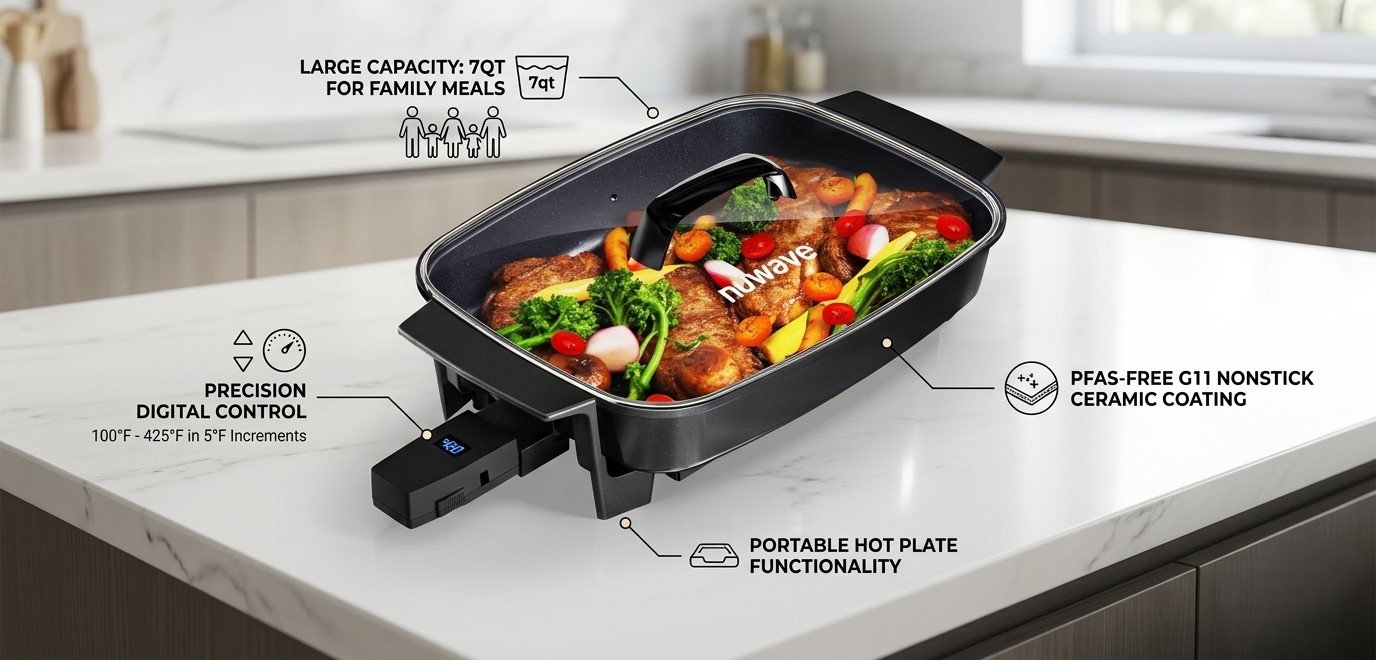
Countertop electric skillets have quietly become one of the more useful appliances in modern kitchens, sitting somewhere between a stovetop pan and a slow cooker in terms of flexibility. They free up burner space, offer a wide cooking surface, and in many cases give home cooks a level of temperature control that a traditional skillet simply can’t match. The Nuwave Medley XL Digital Electric Skillet is one option in this category, built around a large 16 x 12-inch cooking surface, a 7-quart capacity, and a digital temperature system that allows adjustments in 5-degree increments between 100°F and 425°F.
What makes this appliance worth a closer look isn’t a single standout feature but the way several design choices work together: a nonstick ceramic coating formulated without PFAS, a heat shield intended to reduce cold spots, a vented glass lid for monitoring food without lifting it, and a lightweight, portable build that can move from a kitchen counter to a patio table or an RV galley. This article walks through what the skillet offers, how it might fit into different cooking routines, and what to keep in mind before deciding whether it belongs in your kitchen. Nothing here is meant as a personal endorsement or a claim of hands-on testing — it’s a breakdown of the product’s stated specifications and design intent, along with general context about how electric skillets function, so you can evaluate the fit for your own needs.
Key Features
Family-Size Cooking Surface and 7-Quart Capacity
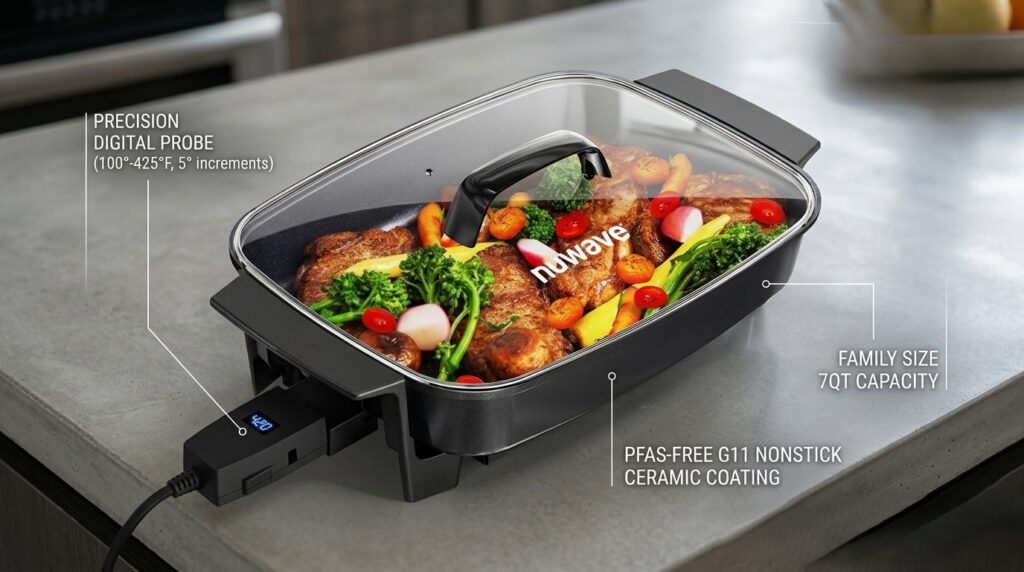
The most immediately noticeable feature of the Medley XL is its size. At 16 inches by 12 inches, the cooking surface is considerably larger than a typical stovetop frying pan, and the raised sidewalls give it an overall capacity of around 7 quarts. That combination means it can handle dishes that would normally require two pans, or a pan plus a pot, on a conventional stove. Pancakes for a full table, a pound or two of ground meat browning alongside vegetables, or a one-pot stew with enough volume for leftovers are all within reach of a single unit this size.
Digital Temperature Control in 5-Degree Increments
Where many electric skillets rely on a dial with broad, unlabeled settings — often jumping in increments of 25 to 50 degrees — the Medley XL uses a digital display paired with a turn knob that allows adjustments in 5-degree steps across a 100°F to 425°F range. This finer level of control is meant to make it easier to hold a precise temperature for tasks like tempering chocolate, maintaining a gentle simmer, or searing at a specific heat without overshooting. A digital probe monitors the cooking surface and is designed to shut the unit off automatically when removed, which is both a convenience and a safety measure.
Heat Shield and Embedded Heating Element
Underneath the cooking surface, the skillet uses an embedded heating element paired with a heat shield that’s designed to reflect warmth back up into the pan rather than letting it escape outward. The stated goal is more even heat distribution across the entire surface, reducing the likelihood of cold spots that can leave part of a dish undercooked while another part is ready. Even heating tends to matter most with large-format cooking, since a bigger surface area gives heat more opportunity to distribute unevenly if the element and shielding aren’t designed with that in mind.
G11 Nonstick Ceramic Coating, PFAS-Free
The interior cooking surface uses what Nuwave describes as its G11 generation of ceramic nonstick coating, positioned as a more durable evolution of earlier ceramic formulas. Ceramic nonstick coatings are typically valued for two reasons: they tend to resist scratching a bit better than some other nonstick surfaces when used with proper utensils, and they’re manufactured without PFAS (per- and polyfluoroalkyl substances), a category of synthetic chemicals that has drawn increasing scrutiny in recent years for its persistence in the environment and potential health implications. Being PFAS-free also generally means the coating avoids PFOA and PTFE, chemicals historically associated with older nonstick technologies. This doesn’t mean ceramic coatings are indestructible — like any nonstick surface, longevity depends heavily on the utensils and cleaning methods used — but it does address a specific and increasingly common consumer concern.
Vented Tempered Glass Lid
A tempered glass lid comes included, which allows you to watch food cook without lifting it and losing heat or moisture. The lid includes venting, which helps manage steam buildup during covered cooking — useful for tasks like simmering sauces or steaming vegetables where trapped condensation could otherwise drip back onto the food in unwanted amounts.
Portability and Lightweight Design
Weighing under 7 pounds according to manufacturer specifications, the Medley XL is light enough to carry from a kitchen to a dining table, a garage, a camper, or a tailgate setup. It runs on standard household current, meaning it doesn’t require anything beyond a normal wall outlet. This portability is part of why electric skillets in general have found a following among people who cook in spaces without full kitchen setups — dorm rooms, small apartments, RVs, and job sites among them.
Cool-Touch Handles and Dishwasher-Safe Components
The handles are designed to stay cool to the touch during operation, reducing the risk of accidental burns when moving or adjusting the skillet mid-cook. Most components other than the digital probe are dishwasher safe, which simplifies cleanup considerably compared to cookware that requires careful hand-washing.
Timer Function
A built-in timer — reported to run up to 10 hours — allows for extended, hands-off cooking. This is particularly relevant for slow-cooking applications, where a lower temperature is held for a long stretch of time without requiring constant attention.
How It Can Be Used
Electric skillets occupy a flexible space in the kitchen, and the Medley XL’s feature set points toward a fairly wide range of applications.
Everyday stovetop replacement. For basic tasks like scrambling eggs, searing chicken breasts, or sautéing vegetables, the skillet can function much like a regular frying pan, with the added benefit of a large surface that reduces the need to cook in batches.
Griddle-style cooking. With its flat, wide surface, the skillet lends itself well to pancakes, French toast, grilled sandwiches, and similar griddle-format foods, especially when cooking for a group.
One-pot meals. The combination of high sidewalls and a 7-quart capacity makes it suitable for chili, stews, pasta sauces, and braises — dishes that benefit from a deep vessel and steady, adjustable heat.
Slow and low-temperature cooking. Because the temperature range starts as low as 100°F, the skillet can be used for gentler cooking tasks: keeping food warm for serving, slow-simmering sauces, or holding a low temperature for extended braises with the help of the timer.
Searing and higher-heat cooking. At the top end of its range, 425°F, the skillet can handle searing meats or achieving a browned crust on foods that benefit from higher, more direct heat.
Portable and away-from-home cooking. Because it only needs a standard outlet, the skillet can travel to potlucks, tailgates, or vacation rentals, and some owners use similar appliances in RVs or campsites where a full range isn’t available.
Freeing up stovetop and oven space. During holidays or large gatherings, having a second independent cooking surface can relieve pressure on a stovetop that’s already juggling multiple pots, particularly for dishes like stuffing, casseroles, or side dishes that don’t need oven space.
Who It May Be Suitable For
Because of its size and feature set, this type of appliance tends to appeal to a fairly specific range of households and situations, though of course individual needs vary.
Larger households or those who cook in batches. Families who regularly prepare meals for four or more people, or who like to cook in bulk for the week ahead, may find the extra surface area and capacity genuinely useful rather than excessive.
People who entertain or host regularly. The combination of a large cooking surface and portability makes this kind of skillet a reasonable fit for potlucks, holiday cooking, or situations where extra cooking capacity is needed temporarily rather than as a daily driver.
Those living in spaces with limited kitchen setups. College students, people in small apartments, or those in transitional housing situations sometimes rely on electric skillets as a substitute for, or supplement to, a conventional stove.
RV owners, campers, and people who travel with a kitchen setup. The lightweight design and standard-outlet requirement make it a plausible option for mobile cooking, provided there’s reliable access to electricity.
Anyone prioritizing PFAS-free cookware. People specifically trying to move away from PFAS-containing nonstick products, whether for environmental or health-related reasons, may find the coating specification relevant to their decision-making, independent of the appliance’s other features.
Cooks who value precise temperature control. Bakers, candy-makers, and anyone who follows recipes with specific temperature requirements (like tempering chocolate or frying at a controlled oil temperature) may appreciate the 5-degree adjustment increments more than someone who cooks primarily by feel.
On the other hand, a large-format electric skillet may be less appealing to people cooking primarily for one or two individuals, those with very limited counter or storage space, or anyone who already has a full range and doesn’t anticipate needing a secondary cooking surface.
Important Things to Consider
Storage space. A 16 x 12-inch appliance, even a light one, takes up meaningful counter or cabinet space. It’s worth considering where it will live between uses before purchasing, particularly in smaller kitchens.
Nonstick coating care over time. Like all nonstick cookware, ceramic coatings generally last longer when used with silicone, wood, or plastic utensils rather than metal, and when hand-washed or otherwise treated gently even if listed as dishwasher safe. Overheating empty nonstick cookware, using metal utensils, or stacking other items on top of the cooking surface can shorten the lifespan of any nonstick coating, ceramic or otherwise.
Wattage and power draw. Electric skillets in this size class typically draw somewhere in the range of 1,200 to 1,500 watts, which is a meaningful amount of power for a single outlet. It’s a good idea to avoid running other high-draw appliances on the same circuit simultaneously, and to check the specific wattage listed for the current model before use, since figures can vary slightly between production versions.
Learning curve for digital controls. For anyone used to a simple analog dial, a digital display with a turn knob may take a short adjustment period, though most users acclimate quickly given how common digital interfaces have become on kitchen appliances.
Not a full stove replacement. While versatile, an electric skillet has a single flat heating zone and a maximum temperature well below what some stovetop burners or ovens can reach. It’s better understood as a complement to existing cooking equipment rather than a wholesale replacement for a range, particularly for tasks like deep boiling large pots of water or high-heat wok cooking.
Lid venting and moisture management. A vented glass lid helps manage steam, but it also means it isn’t fully airtight, which matters for certain slow-cooking or braising techniques where moisture retention is a priority. Understanding how the venting behaves in practice can help set expectations for covered cooking.
Cord length and outlet placement. As with any countertop appliance, it’s worth checking where the nearest outlet is relative to where you intend to use the skillet, since cord length and placement affect convenience, especially for portable or outdoor use.
Comparison of General Categories
It can help to place the Medley XL within the broader landscape of cooking equipment rather than evaluating it in isolation.
Electric skillets versus traditional stovetop skillets. A traditional stovetop skillet (whether stainless, cast iron, or nonstick) depends on a burner for heat and generally requires more hands-on temperature management, since most stovetops use dial-based, non-digital heat settings. Electric skillets, by contrast, bring their own self-contained heating element and, in digital models, offer more precise and consistent temperature holding. The tradeoff is that stovetop skillets are usually lighter, more compact for storage, and often more affordable, while electric skillets take up more space but offer independence from the stove and often a larger cooking surface.
Electric skillets versus griddles. Standalone electric griddles are typically flatter, with little to no sidewall, and are optimized for foods like pancakes, eggs, and grilled sandwiches rather than dishes with sauce or liquid. An electric skillet with raised sides, like the Medley XL, sits in between a griddle and a pot, capable of griddle-style cooking as well as stews, braises, and other dishes that need contained liquid. Someone who cooks almost exclusively flat foods might find a dedicated griddle sufficient, while someone who wants more versatility may lean toward a skillet-style unit.
Electric skillets versus multicookers (like pressure cookers or slow cookers). Multicookers are generally enclosed, sealed appliances optimized for hands-off cooking over longer periods, often with pressure or slow-cook functions that aren’t replicated by an open skillet. Electric skillets, on the other hand, allow direct visual and physical access to food throughout cooking, which suits tasks like searing, flipping, or stirring that multicookers handle less naturally. The two categories are often complementary rather than competing, since they’re suited to different cooking styles.
Ceramic nonstick versus PTFE-based nonstick coatings. Traditional PTFE (Teflon-type) nonstick coatings have long been valued for their slickness and durability at moderate temperatures but have drawn concern due to PFOA historically used in manufacturing (largely phased out industry-wide) and the potential for the coating to degrade and release fumes at very high temperatures. Ceramic coatings, including the type used here, are generally marketed as a PFAS-free alternative, though they can sometimes lose nonstick effectiveness a bit faster with heavy use compared to some PTFE coatings, depending on quality and care. Neither category is universally “better” — the right choice depends on individual priorities around chemical composition, durability, and cost.
None of these comparisons are meant to declare one category superior across the board; they’re offered to help clarify where a large digital electric skillet fits relative to other tools you may already own or be considering.
Frequently Asked Questions
Is the Nuwave Medley XL suitable for daily cooking, or is it more of an occasional-use appliance? It can be used for daily cooking, particularly by households that regularly prepare meals for several people or who like having a large, flat cooking surface available. That said, some buyers use similar skillets more occasionally, for entertaining or for specific dishes that benefit from a bigger pan, while relying on a stovetop for everyday smaller-scale cooking.
Can it be used outdoors, such as on a patio or during camping? As long as there’s access to a standard electrical outlet and the unit is used according to the manufacturer’s safety guidelines, it can generally be used outdoors or while traveling. It’s not designed to run on battery power or a stovetop-style open flame, so an electrical connection is necessary.
How does the temperature range compare to a standard stovetop? Home stovetop burners can typically exceed the skillet’s 425°F maximum, especially on high heat, which matters for tasks like flash-searing or achieving a very hard sear. On the lower end, the skillet’s ability to hold a stable temperature as low as 100°F can actually offer more consistency than a stovetop’s lowest simmer setting, which can be harder to regulate precisely on some ranges.
Is the glass lid oven-safe or can it go under a broiler? Electric skillet lids, including tempered glass ones, are generally designed for stovetop-style covered cooking on the countertop appliance itself, not for oven or broiler use. It’s worth checking the specific care and use instructions included with the unit rather than assuming compatibility with other appliances.
What’s the best way to clean the nonstick surface without damaging it? General best practice for ceramic nonstick cookware includes using non-abrasive sponges, avoiding metal scouring pads, and letting the pan cool before washing. Even if listed as dishwasher safe, many people find hand-washing extends the life of a nonstick coating over repeated use.
Does the digital probe need to be removed before washing the base? Yes, in most electric skillet designs, including this one, the digital temperature probe is not submersible and needs to be detached before the cooking base or lid go into a sink or dishwasher. The probe area typically just needs a wipe-down with a damp cloth.
Can it replace an oven for baking-style dishes? Not fully. While the skillet can handle some baking-adjacent tasks like cornbread or certain casseroles when covered, it lacks the enclosed, all-around heat of a true oven, so texture and rise on baked goods may differ from oven results.
Is 7-quart capacity accurate for how much food actually fits? The 7-quart figure refers to the skillet’s total volume capacity including the raised sidewalls, not necessarily the amount of food you’d comfortably cook at once. As with any cookware, leaving some headroom for stirring, boiling, or bubbling liquid is generally advisable rather than filling to the very top.
Conclusion
The Nuwave Medley XL Digital Electric Skillet is built around a fairly clear set of priorities: a large cooking surface for family-size or batch cooking, more precise digital temperature control than a typical analog skillet offers, a PFAS-free nonstick coating for those concerned about that category of chemicals, and a lightweight, portable design that can move beyond the kitchen when needed. It won’t replace a full range for every task, and like any nonstick cookware, its longevity depends significantly on how it’s used and cared for. But for households that regularly cook larger quantities, want more temperature precision than a basic dial provides, or need a flexible cooking surface that isn’t tied to a fixed stovetop, it represents one reasonable option among the growing category of digital electric skillets.
As with any kitchen appliance purchase, it’s worth weighing your own cooking habits, available storage space, and specific priorities (whether that’s capacity, portability, or coating type) against what this particular model offers before deciding if it’s the right fit.