Introduction
Anyone who has hosted a holiday dinner, a potluck, or a casual weekend get-together knows the logistical puzzle that comes with it: how do you keep multiple dishes warm, presentable, and ready to serve without turning your kitchen counter into a maze of mismatched appliances? This is the exact problem that multi-pot buffet servers were designed to solve, and the Sunvivi Triple Slow Cooker, Buffet Server and Food Warmer is one example of this category of small kitchen appliance.
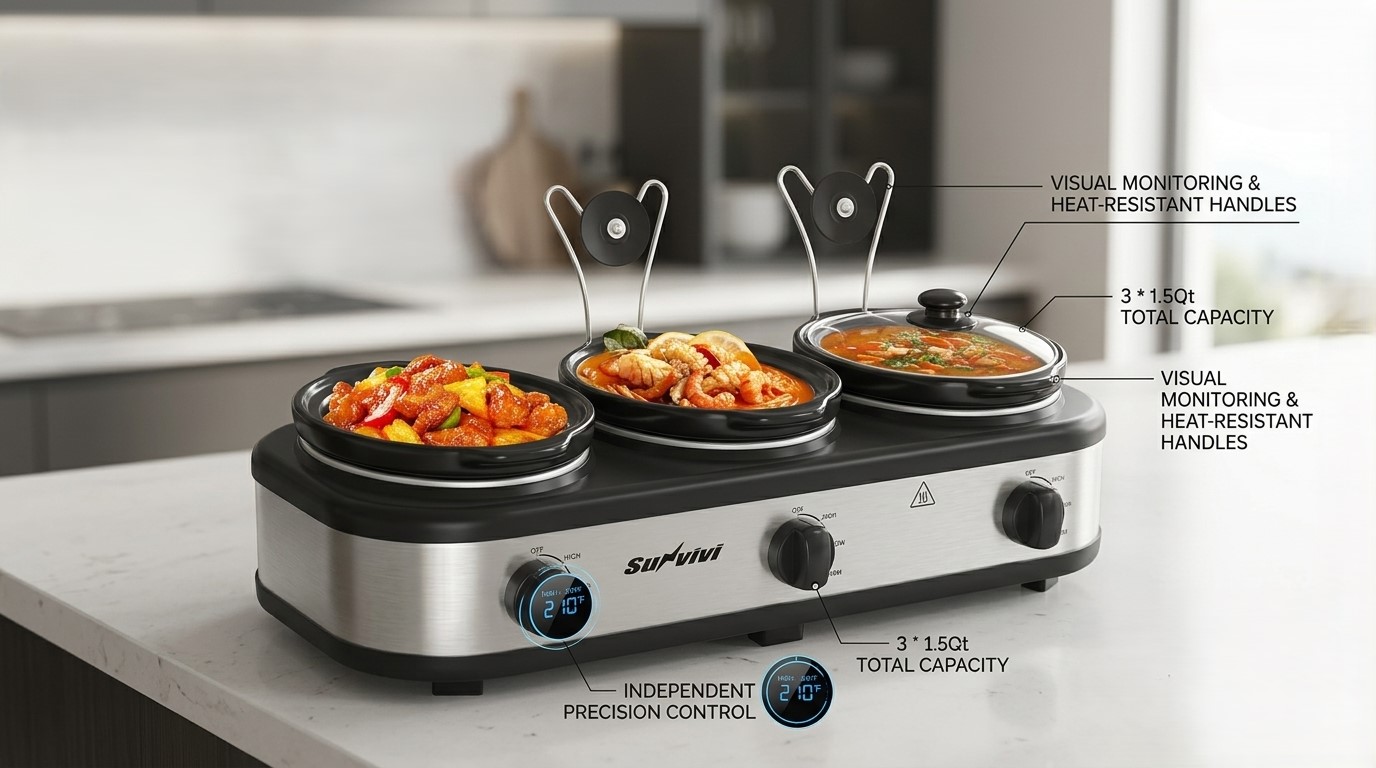
Built around three separate 1.5-quart crocks housed in a single stainless steel frame, this unit is marketed toward people who regularly find themselves serving more than one dish at a time — think mac and cheese next to baked beans next to a warm queso dip, all sitting side by side on the same buffet table. Rather than juggling three individual slow cookers, each with its own cord, base, and footprint, this style of appliance consolidates everything into one compact unit with three independently controlled sections.
In this article, we’ll walk through what this type of product actually offers, how it tends to get used in real kitchens and event settings, who it may be a good fit for, and a few practical details worth thinking about before adding one to your collection of entertaining gear. We’ll also place it in context alongside other common warming and serving options, so you can decide whether this particular format lines up with how you actually cook and host.
Key Features
Three Independent 1.5-Quart Crocks
The defining trait of this appliance is its layout: three separate ceramic or stoneware crocks, each holding roughly 1.5 quarts, for a combined capacity of about 4.5 quarts. Each crock sits over its own heating element, which means the three sections don’t share a single thermostat. One pot can be set to keep a gravy warm on low while another simmers a chili on high, and the third can hold a dip on the warm setting — all at once, without any dish being under- or over-heated because of what’s happening in the pot next to it.
Adjustable Temperature Settings Per Section
Each crock typically offers a small range of settings, generally described as High, Low, and Warm. This mirrors the controls you’d find on a standard single-unit slow cooker, just multiplied by three and made independent of each other. The “Warm” setting in particular is worth noting, since it’s designed less for cooking from raw ingredients and more for holding already-prepared food at a safe, steady serving temperature over an extended period — which is the core function of a buffet server as opposed to a traditional slow cooker.
Visible Glass Lids
Each of the three crocks is topped with its own tempered glass lid, usually with an attached handle for lifting. The clear glass allows you to check on food — whether that’s monitoring a simmering sauce or simply confirming there’s still enough dip left for guests — without removing the lid and releasing built-up heat and moisture. This is a small detail, but for anyone who has hosted a buffet, being able to glance at three dishes at once without disturbing them is a genuinely useful convenience.
Removable Crocks with Cool-Touch Handles
The individual pots are designed to lift out of the base unit, which serves two purposes. First, it makes cleanup considerably simpler, since you’re not trying to scrub around a fixed heating element. Second, it allows you to prep a dish in the crock ahead of time, refrigerate it, and then place it back into the warming base closer to serving time. The handles on the crocks are built to stay cooler than the crock itself, though as with any appliance that’s been actively heating food, some residual heat transfer is normal and care should still be taken when handling them.
Dishwasher-Safe Components
The ceramic crocks and glass lids are generally dishwasher-safe, which matters more than it might initially seem for a product aimed at entertaining. After a holiday dinner or a long party, the last thing most hosts want is a pile of hand-wash-only cookware. Being able to load the inserts into a dishwasher — while keeping the electrical base itself away from water, as is standard practice for any electric appliance — helps keep post-event cleanup manageable.
Stainless Steel Housing with Non-Slip Feet
The outer frame connecting the three crocks is made of stainless steel, giving it a finish that tends to coordinate reasonably well with other stainless kitchen appliances and serving pieces. Rubberized or non-slip feet on the base help keep the unit stable on a buffet table or countertop, which is a meaningful detail given that a fully loaded three-crock server, with food in every section, has some real weight and surface area to it.
Included Serving Spoons
Many versions of this product ship with a set of heat-resistant serving spoons — often one per crock — so guests or hosts have a dedicated utensil for each dish rather than searching the kitchen for enough serving pieces mid-event.
Compact, Purpose-Built Footprint
Because the three crocks are built into a single connected frame rather than three separate stand-alone units, the overall footprint is more efficient than lining up three individual slow cookers side by side. It still occupies a reasonably long stretch of counter or table space, given that it’s built as an oval, elongated shape to accommodate three pots in a row, but it consolidates three power needs into a single cord and base.

How It Can Be Used
Holiday and Family Gatherings
The most obvious use case is exactly what the product name suggests: buffet-style serving for holidays, family dinners, and multi-course meals where more than one hot side dish needs to stay at temperature for an extended period. Stuffing, mashed potatoes, and gravy; or green bean casserole, candied yams, and cranberry sauce — the three-crock format lends itself naturally to the “several sides, one table” format common at Thanksgiving, Christmas, and other holiday meals.
Potlucks and Casual Entertaining
For potluck-style gatherings, having a single appliance that can hold three different contributions warm — rather than needing three separate slow cookers plugged in around the kitchen — simplifies both the cooking and the serving side of hosting. It also means a host can prepare three different dishes without needing three different pieces of equipment taking up storage space the rest of the year.
Dip and Appetizer Stations
Because each crock has a genuine “Warm” setting, the appliance works well for building an appetizer or dip station: a warm spinach-artichoke dip in one crock, queso in another, and a barbecue meatball mix in the third, for example. This kind of setup is common at game-day gatherings, casual parties, and open houses where guests are expected to graze over a longer stretch of time rather than sit down for a single formal meal.
Breakfast and Brunch Buffets
The same three-zone format can be adapted for brunch service — one crock for warm oatmeal or grits, one for breakfast casserole, and one for sausage gravy, as an example. Anyone hosting a larger brunch, whether for a holiday morning or a baby or bridal shower, may find the format useful outside of the more typical dinner-party context.
Small-Batch, Simultaneous Cooking
While the primary design intent leans toward warming and holding already-prepared food, the individual crocks can also be used to slow-cook smaller batches of food from a raw or partially prepared state, similar to a standard compact slow cooker. This is useful for households that want to prepare three modest portions of different dishes at once — for instance, cooking three different proteins or side dishes to accommodate different family members’ preferences or dietary needs in a single session.
Events, Office Parties, and Catering-Style Setups
Because the unit is self-contained and relatively easy to transport (once cooled and emptied), it also gets used for office potlucks, community events, and smaller catering setups where a host needs a presentable, functional warming station without renting full-scale chafing equipment.
Who It May Be Suitable For
- Frequent hosts and entertainers. If holiday dinners, potlucks, or regular get-togethers are a normal part of your household’s calendar, having a dedicated multi-dish warming appliance can reduce the juggling that comes with keeping several dishes at serving temperature simultaneously.
- Households with varied tastes or dietary needs. Families that regularly need to prepare more than one version of a dish — a vegetarian option alongside a meat-based one, for example — may appreciate being able to run three independent temperature zones at once.
- People with limited kitchen storage. Because this consolidates the function of three separate slow cookers into a single unit, it can be a more storage-efficient option than owning three individual appliances, particularly for anyone in an apartment or smaller kitchen.
- Anyone who serves buffet-style rather than plated meals. The format is built specifically around self-serve, help-yourself dining, which fits gatherings where guests move through a table at their own pace rather than sitting down to a single served course.
- Small offices, clubs, or community groups. Organizations that host recurring potlucks or catered meetings may find the multi-pot format practical for keeping several dishes warm through a longer event.
On the other hand, it may be less useful for people who primarily cook single large-batch meals (a full pot roast or a big batch of soup for the week, for instance), since each individual crock’s 1.5-quart capacity is modest compared to a standard 6- to 8-quart single slow cooker. Households with very limited counter or storage space, or those who rarely host more than one dish at a time, may also find a simpler, single-pot slow cooker better suited to their day-to-day needs.
Important Things to Consider
Per-crock capacity is modest. At roughly 1.5 quarts per section, each individual crock is closer in size to a “mini” or dip-sized slow cooker than to a full family-dinner slow cooker. This is by design — the format favors variety over volume — but it’s worth keeping in mind if your goal is to feed a large group from a single dish rather than serving three smaller dishes side by side.
Power and outlet planning. As with any electric warming appliance, it needs to be plugged in and positioned near an outlet, and running all three crocks at once draws more power than operating a single slow cooker. If you’re setting up a buffet table away from your kitchen — in a dining room or on a porch, for example — it’s worth planning your outlet access and extension cord needs ahead of time.
Care after use. Because the crocks and their handles can retain heat after cooking, it’s generally advisable to let the unit cool for a period before handling the inserts directly, and to use the included spoons or oven mitts rather than bare hands immediately after a long warming session.
Footprint on the table. With three crocks arranged in a row inside a single housing, the overall unit is elongated — closer to two feet in length in most versions of this product — so it needs a reasonably long, clear stretch of counter or table space. This is worth measuring against your buffet table or countertop before assuming it will fit alongside other serving dishes.
Glass lid care. The lids are tempered glass, which is generally more durable than standard glass but still requires reasonable care during transport, storage, and cleaning to avoid chips or cracks, particularly around the lid handles.
Cooking versus holding. It’s worth understanding the difference between a dish’s active cooking time and its “keep warm” time. Like most slow cookers, this type of appliance is well suited to holding already-cooked or slow-cooked food at temperature for a long stretch, but if you’re cooking raw ingredients from scratch, cook times will vary by recipe, ingredient, and how full each crock is — general slow-cooking guidance still applies.
Manufacturer specifications can vary slightly by listing and color variant. Wattage, exact dimensions, and included accessories have shown some variation across different color and packaging versions of this product line, so it’s worth checking the specific listing you’re considering for the precise details relevant to that version.
How Triple Slow Cookers Compare to Other Warming and Serving Options
Choosing the right kind of warming or serving equipment often comes down to how you host, not just what looks appealing. Here’s a general comparison of a few common categories, without singling out any specific competing brand:
| Category | Typical Strengths | Typical Trade-Offs |
|---|---|---|
| Triple/multi-pot slow cooker & buffet server (this product’s category) | Runs several dishes at independent temperatures in one unit; efficient use of counter space and outlets compared to multiple separate slow cookers; suited to buffet-style, self-serve entertaining | Each crock holds a smaller portion than a full-size single slow cooker; needs a longer stretch of table or counter space; not ideal if you only ever need to serve one large dish |
| Traditional single slow cooker | Larger capacity per pot (often 6–8 quarts), suited to feeding a large group from one dish; simpler to store and clean; widely used for both cooking and holding food | Limited to one dish and one temperature at a time; multiple dishes require multiple units and outlets |
| Chafing dish sets | Classic buffet presentation; often used for catered or formal events; no electricity required if using fuel cans | Requires fuel or heat source management; typically needs food to be fully cooked elsewhere beforehand; can be bulkier to store and transport |
| Electric warming trays | Flat, flexible surface that can hold various dish shapes and sizes; simple to use | Less precise temperature control per dish; not designed for active cooking, only for holding pre-cooked food |
None of these categories is universally “better” — the right choice depends on how many dishes you typically serve at once, whether you need to actively cook or simply hold food warm, how much storage space you have, and the kind of events you host most often.
Frequently Asked Questions
Can all three crocks really be set to different temperatures at the same time? Yes — this is the core feature of the design. Each crock has its own independent heating element and control, so one section can run on High while another sits on Low or Warm, without affecting the other sections.
Is this appliance meant for cooking raw food, or just for keeping food warm? It can generally do both. Like a standard slow cooker, it can cook food from a raw or partially prepared state on Low or High settings, and it can also be used purely to hold already-cooked food at a safe serving temperature using the Warm setting — which is the more common use case at parties and buffets.
Are the crocks and lids dishwasher-safe? The ceramic or stoneware crocks and the glass lids are typically dishwasher-safe. The electrical base itself, like any plugged-in appliance, should not be submerged or run through a dishwasher — it’s generally wiped clean by hand instead.
How much food does each crock actually hold? Each of the three sections holds approximately 1.5 quarts, for a combined total of around 4.5 quarts across all three. That’s enough for a modest side dish, dip, or appetizer portion per crock rather than a large single entrée for a big group.
Can it be used outside the kitchen, like on a porch or at an outdoor event? As long as there’s access to a standard electrical outlet and the unit is kept on a stable, level surface, it can generally be used outside the kitchen — for instance, on a patio table during a cookout — though, like any electric appliance, it isn’t designed for exposure to rain or wet conditions.
Does it come with serving utensils? Many versions of this product include a set of heat-resistant serving spoons, generally one for each crock, though it’s worth confirming this detail on the specific listing you’re viewing, since inclusions can vary slightly between color variants and packaging.
How long can food safely stay on the Warm setting? General food safety guidance suggests hot food should be kept at or above 140°F (60°C) to remain safe for extended holding, and most warming appliances like this one are designed with that kind of range in mind. As with any warming appliance, it’s worth using a food thermometer periodically during longer events and following standard food safety practices for how long perishable dishes should sit out, even while being kept warm.
Is it heavy or difficult to move once it’s set up? The stainless steel housing and three ceramic crocks give it some real weight, particularly once all three sections are filled with food. It’s generally designed to be set up in place rather than moved frequently once it’s plugged in and loaded, though it can be transported when empty and cooled.
Conclusion
For anyone who regularly finds themselves managing more than one hot dish at a gathering — whether that’s a holiday dinner with several sides, a potluck contribution, or a dip station for a casual party — a triple-crock buffet server like this one addresses a fairly specific but common hosting challenge. It won’t replace a full-size slow cooker for large single-dish meals, and its footprint requires a reasonable stretch of table or counter space, but for buffet-style, multi-dish serving, the combination of independent temperature zones, visible glass lids, and dishwasher-safe components covers most of what that kind of entertaining setup requires.