Introduction
Slow cooking has held a steady place in home kitchens for decades, and for good reason. There’s something genuinely appealing about the idea of adding ingredients to a pot in the morning and coming back hours later to a finished meal. Among the many slow cookers on the market, the Crock-Pot 7-Quart Manual Slow Cooker stands out simply because of its size and simplicity. It’s built for larger households, batch cooking, or anyone who regularly hosts family dinners and wants a straightforward appliance without a lot of digital fuss.
This article walks through what this particular slow cooker offers, how people typically use appliances of this size and type, who might find it useful, and what’s worth thinking about before adding one to a kitchen. The goal here isn’t to convince anyone that this is “the best” slow cooker on the market — that’s a subjective call that depends on personal cooking habits, kitchen space, and household size. Instead, this is meant to be an informative look at the product category and this specific model’s features, so readers can decide for themselves whether it fits their needs.
Key Features
7-Quart Capacity
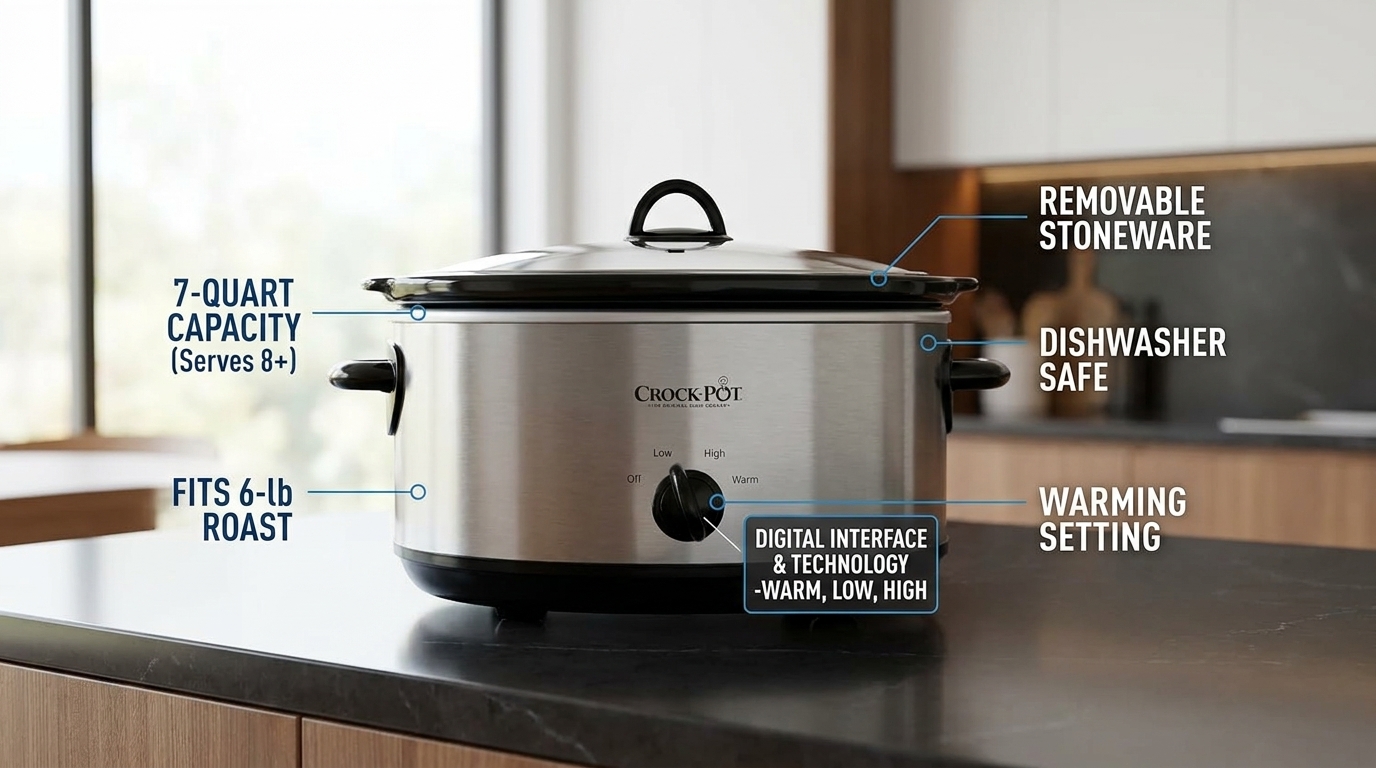
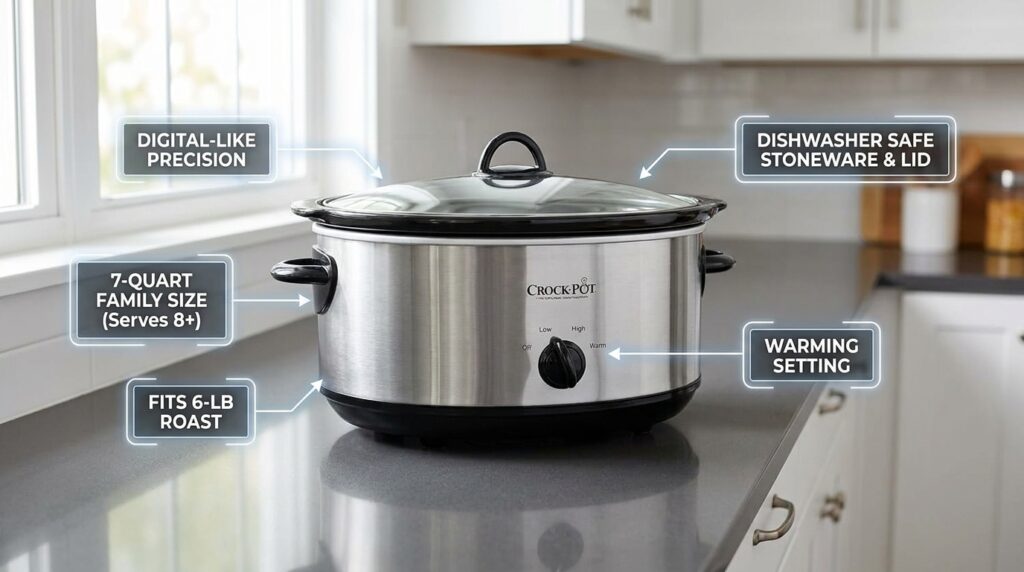
The defining characteristic of this slow cooker is its size. A 7-quart capacity puts it firmly in the “family size” category, as opposed to smaller 3-quart or 4-quart models that are typically marketed toward singles, couples, or side-dish preparation. With 7 quarts of usable space, this cooker is generally described as suitable for feeding eight or more people, depending on the recipe and how it’s portioned.
This capacity also means it can accommodate larger cuts of meat — the product listing notes it can fit a roast of up to 6 pounds, which is relevant for anyone who regularly cooks whole chickens, pork shoulders, briskets, or large roasts for family meals or gatherings.
Manual Dial Controls
Unlike many newer slow cookers that come with digital timers, programmable settings, or app connectivity, this model uses manual dial controls. Typically, manual slow cookers in this category offer a small number of straightforward settings — commonly Low, High, and Warm. There’s no screen to navigate and no buttons to program. For some users, this simplicity is a selling point in itself: fewer components that can malfunction, and no learning curve involved in figuring out a digital interface.
Removable Stoneware Insert
The stoneware insert is designed to lift out of the outer heating base, which serves a couple of practical purposes. First, it makes serving more convenient, since the insert can be brought to the table directly rather than requiring food to be transferred to another serving dish. Second, it simplifies cleanup, since the insert can be washed separately from the electrical base (which, like most slow cookers, should never be submerged in water).
Warming Setting
Beyond the Low and High cooking settings, this model includes a Warm setting. This is a lower-heat mode intended to keep already-cooked food at a safe serving temperature without continuing to cook it further. This can be particularly useful for potlucks, holiday meals, or any situation where food needs to stay ready to serve over an extended period without drying out or overcooking.
Dishwasher-Safe Components
The stoneware insert and lid are described as dishwasher safe, which is a meaningful convenience feature for a pot of this size. Hand-washing a 7-quart stoneware insert can be a bit of an undertaking given its dimensions, so being able to place it in a dishwasher can save a fair amount of time and effort, especially after cooking for a larger group.
Stainless Steel Exterior
The exterior housing is stainless steel, which is a common choice for kitchen appliances because it tends to resist staining, is relatively easy to wipe down, and generally has a neutral appearance that fits into most kitchen aesthetics without clashing with other appliances or décor.
How It Can Be Used
A slow cooker of this size opens up a fairly wide range of cooking possibilities, particularly for people who cook for more than two or three people on a regular basis. Here are some of the more common ways a 7-quart manual slow cooker like this one tends to get used.
Large-Batch Meals
Because of its size, this slow cooker is well suited to recipes that are meant to feed a crowd or produce leftovers for the week. Chili, stews, soups, and casseroles are all dishes that scale well in a larger cooker, and having extra capacity means there’s less need to cook in multiple batches.
Whole Roasts and Large Cuts of Meat
With enough room for up to a 6-pound roast, this cooker can handle whole chickens, pork shoulders, beef roasts, and similar cuts that wouldn’t comfortably fit in a smaller unit. Slow cooking larger cuts of meat at a low, steady temperature over several hours is a common method for achieving tender results, particularly with tougher cuts that benefit from long, gentle cooking.
Holiday and Gathering Cooking
Families that host holiday meals or regular gatherings often find that a larger slow cooker becomes useful as a secondary cooking appliance. While the oven handles a turkey or ham, a slow cooker can simultaneously prepare side dishes like mashed potatoes, baked beans, mac and cheese, or stuffing, freeing up stovetop and oven space.
Meal Prep for the Week
Some people use a large slow cooker specifically for weekly meal prep, cooking a big batch of a protein or a stew-type dish on a weekend and portioning it out for lunches or dinners throughout the week. The 7-quart size accommodates this kind of batch cooking more comfortably than smaller models.
Keeping Food Warm for Serving
The Warm setting is often used less for cooking and more for holding already-prepared food at serving temperature. This can come in handy for potlucks, buffet-style meals, or any event where food needs to stay accessible and warm over a few hours without continuing to cook.
Basic Dessert and Bread Recipes
While not its primary function, slow cookers of this size are sometimes used for recipes like bread pudding, certain cakes, or slow-cooked fruit desserts. These aren’t the most common use cases, but they’re worth mentioning as an example of the versatility that a large stoneware insert can offer beyond savory main dishes.
Who It May Be Suitable For
Because slow cooker needs vary so much from household to household, it’s worth thinking through who tends to get the most value out of a larger, manual-control model like this one.
Larger households. Families of four or more, particularly those who like having leftovers or who feed growing kids and teenagers, often find that smaller slow cookers just don’t produce enough food in one batch. A 7-quart model addresses that gap directly.
People who regularly host. Anyone who frequently has people over — whether for holidays, game nights, or regular family dinners — may appreciate having a cooker that can handle a full-sized dish without needing to double a recipe across two pots.
Those who prefer simple appliances. Not everyone wants a slow cooker with a digital display, Wi-Fi connectivity, or multiple pre-programmed settings. Some people specifically prefer the tactile simplicity of a dial, especially if they’ve used manual slow cookers for years and don’t feel the need to switch to something more complex.
Meal preppers and batch cooks. People who cook in bulk to prepare meals for the week, or who like to freeze portions for later, often benefit from the extra capacity a 7-quart cooker provides, since it reduces the number of cooking cycles needed to produce a given amount of food.
Budget-conscious buyers who still want size. Manual slow cookers are typically simpler in construction than their programmable counterparts, which can make them a practical option for someone who wants a large-capacity cooker without paying for extra digital features they may not use.
On the other hand, this type of cooker may be less appealing to people who live alone, cook primarily for one or two people, or who specifically want programmable features like delayed start times or automatic switch-to-warm functions tied to a timer rather than manual adjustment. Smaller households might find a 7-quart cooker more space than they need, both in terms of food quantity and physical storage footprint in the kitchen.
Important Things to Consider
Before choosing any slow cooker, especially one of this size, there are a handful of practical factors worth thinking through.
Kitchen Storage Space
A 7-quart slow cooker is a sizable appliance. It’s worth measuring available cabinet or countertop space beforehand, since larger cookers can take up more room than people initially expect, both in terms of footprint and height when the lid is on.
Manual vs. Programmable Controls
Manual slow cookers require someone to be around to physically turn the dial to “Warm” once cooking is finished, or to adjust the cooking temperature if needed. This is different from programmable models, which can automatically switch to a warming setting after a set cook time. For people who are often out of the house for long stretches, this distinction can matter — a manual cooker won’t adjust itself if a recipe finishes cooking before someone gets home.
Cooking Time Adjustments for Larger Batches
Recipes written for smaller slow cookers may need cooking time adjustments when scaled up to a 7-quart size, since a fuller pot can behave differently than a partially filled one. It’s generally a good idea to reference recipes designed for similar-sized cookers, or to check food for doneness rather than relying solely on a fixed cook time when using a new appliance for the first time.
Weight and Handling
Filled with a large batch of food, a 7-quart stoneware insert can become fairly heavy. This is worth keeping in mind for anyone who might have difficulty lifting or maneuvering a heavier, hot dish, particularly when transferring it from the base to a table or countertop.
Cleaning Practices
While the stoneware insert and lid are dishwasher safe, the electrical base housing the heating element should not be submerged in water. It typically needs to be wiped down separately with a damp cloth. Understanding this distinction ahead of time can help avoid accidentally damaging the appliance.
Long-Term Durability
As with most kitchen appliances, how long a slow cooker lasts often depends on how it’s used and cared for — for example, avoiding sudden temperature changes with the stoneware (such as adding cold liquid to a very hot insert) can help reduce the risk of cracking. Reading the included care instructions can help extend the appliance’s usable life.
Comparison of General Categories
Rather than comparing this specific model against individual competing products, it can be more helpful to understand how slow cookers as a category generally differ from one another, so readers can evaluate where a 7-quart manual model like this one fits in.
Size Categories
Slow cookers are generally grouped into a few broad size categories:
- Small (1.5–3 quarts): Typically used for dips, sauces, or meals for one to two people.
- Medium (4–5 quarts): A common choice for couples or small families, suitable for moderate-sized meals without much leftover capacity.
- Large (6–8 quarts): Designed for larger families, batch cooking, or hosting, with enough room for whole roasts or multiple side dishes.
A 7-quart model sits toward the upper end of this range, making it one of the more spacious options without moving into extra-large commercial territory.
Manual vs. Digital/Programmable Models
Broadly speaking, slow cookers fall into two control types:
- Manual dial models offer basic Low, High, and Warm settings, controlled entirely by hand. These tend to be simpler mechanically and are often favored by people who want a no-frills appliance.
- Digital or programmable models allow users to set precise cook times, and many will automatically switch to a warming mode once the timer ends. These can be convenient for people who are away from home during cooking but often come with a steeper learning curve and more components that could potentially require troubleshooting over time.
Neither category is inherently better — the right choice really depends on how hands-on someone wants to be with monitoring their cooking.
Insert Material Types
Most slow cookers use either ceramic/stoneware inserts or metal inserts:
- Stoneware inserts (like the one included with this model) tend to retain heat evenly and are generally well suited to slow, gentle cooking. They can be heavier and, in some cases, more prone to cracking if exposed to sudden temperature changes.
- Metal inserts, sometimes found in multi-cookers or pressure cooker hybrids, tend to be lighter and more resistant to thermal shock, though heat distribution can differ from ceramic.
Exterior Material
Exteriors are commonly made from painted metal, plastic, or stainless steel. Stainless steel exteriors, as featured on this model, are generally chosen for their resistance to staining and relatively easy maintenance, though they may show fingerprints more visibly than matte finishes.
Frequently Asked Questions
How many people can a 7-quart slow cooker realistically feed? This depends heavily on the recipe and portion sizes, but a 7-quart capacity is generally associated with feeding eight or more people, which is why it’s often labeled as “family size.”
Can this slow cooker fit a whole chicken or a large roast? According to the product specifications, it can accommodate a roast of up to approximately 6 pounds, which generally covers most whole chickens and many standard roasts.
Is the stoneware insert removable? Yes, the stoneware insert lifts out of the outer housing, which makes it easier to serve food directly from the insert and simplifies cleaning.
Can I put the insert in the dishwasher? The stoneware insert and lid are described as dishwasher safe. The electrical base, however, should not be submerged in water and typically needs to be wiped clean separately.
Does this model have a timer or programmable settings? No — this is a manual slow cooker, meaning it’s operated using a dial rather than digital or programmable controls. It generally includes Low, High, and Warm settings.
What does the Warm setting do? The Warm setting is designed to hold already-cooked food at a safe serving temperature without continuing to cook it, which can be useful for extending serving time during gatherings or potlucks.
Is a 7-quart slow cooker too big for a small household? It can be, depending on cooking habits. Smaller households that don’t often cook in bulk or host guests may find a smaller-capacity slow cooker more practical, both for food quantity and kitchen storage space.
Do I need to adjust recipe cooking times for a larger slow cooker? Recipes are often written with a specific slow cooker size in mind, so it’s worth checking a recipe’s intended capacity and adjusting cook times or checking doneness periodically when using a larger model for the first time.
What is the exterior made of? The exterior housing is stainless steel, a material commonly chosen in kitchen appliances for its durability and relatively low-maintenance upkeep.
Conclusion
The Crock-Pot 7-Quart Manual Slow Cooker fits into a specific niche within the broader slow cooker market: larger capacity, straightforward manual controls, and practical conveniences like a removable, dishwasher-safe stoneware insert. For households that regularly cook for a crowd, host gatherings, or simply prefer batch cooking and leftovers, this kind of appliance can be a useful addition to the kitchen. At the same time, it’s not necessarily the right fit for everyone — smaller households or those who want programmable, timer-based operation may want to weigh other options in the slow cooker category.