Introduction
Kitchen counters have become a lot more crowded over the past decade. Between the coffee maker, the toaster, the blender, and whatever gadget last caught someone’s eye during a late-night scroll, there’s often little room left for one more appliance. That’s part of why “all-in-one” cooking devices have become so popular — the idea of replacing three or four single-purpose tools with a single unit that handles multiple jobs is genuinely appealing for anyone trying to simplify their kitchen setup.
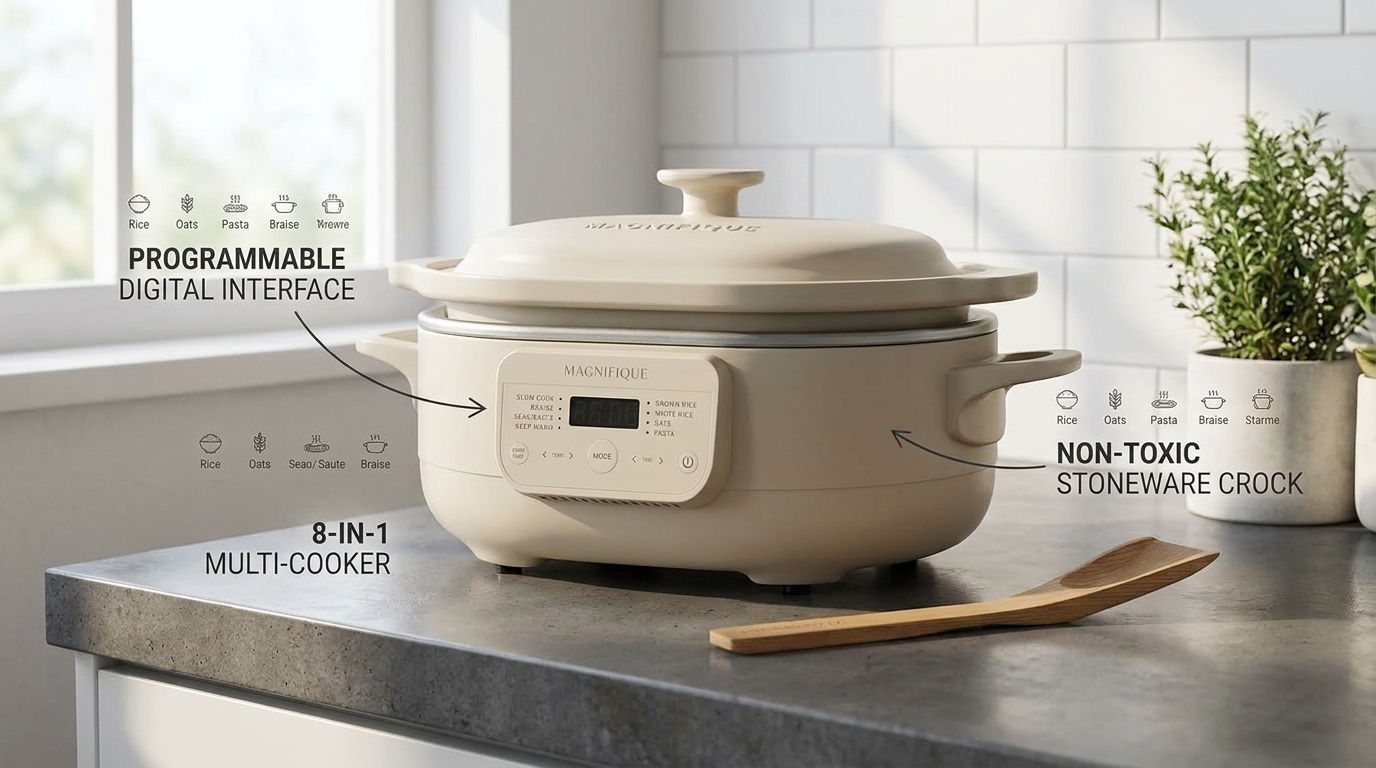
The MAGNIFIQUE 4 Quart Programmable Casserole Slow Cooker fits squarely into that category. It’s marketed as an 8-in-1 multi cooker, built around a removable stoneware crock that’s designed to go from stovetop-style slow cooking to oven use without needing to switch containers. It also leans into a growing consumer interest in non-toxic cookware, since the crock’s coating is formulated without PFAS, PFOA, PTFE, lead, or cadmium — materials that have drawn increasing scrutiny in recent years as more households look for cleaner options in the kitchen.
This article walks through what the appliance actually offers, how it might realistically be used in a day-to-day kitchen, who tends to benefit most from this style of cooker, and a few practical considerations worth thinking through before adding one to your countertop. The goal here isn’t to tell you it’s the “best” anything — it’s to give you a clear, balanced picture so you can decide for yourself whether it fits how you cook.
Key Features
8-in-1 Functionality in a Single Unit
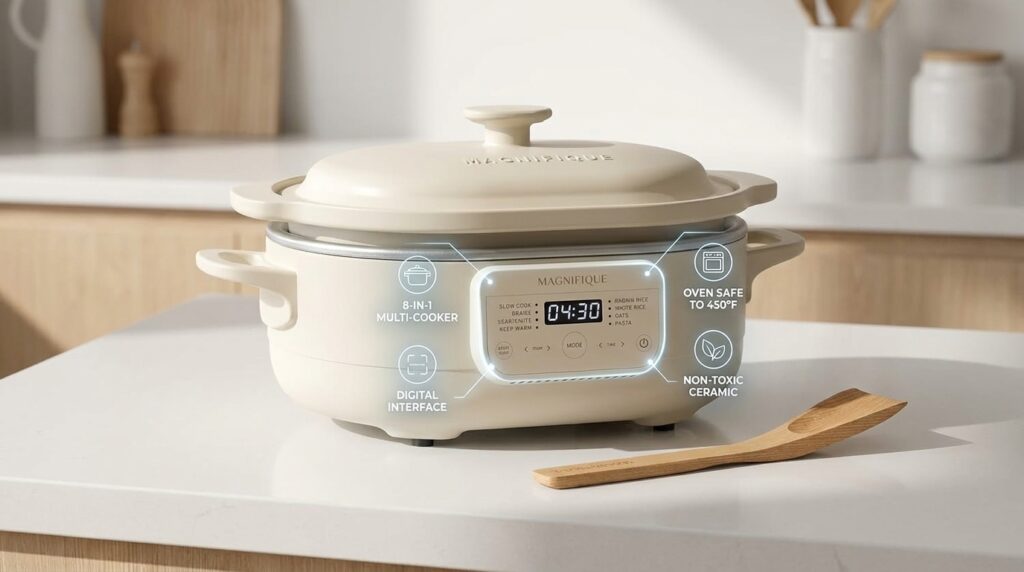
At the center of this appliance’s appeal is its multi-function design. Rather than being limited to a single slow-cook setting the way traditional crock pots often are, this unit is built to handle eight distinct cooking modes: Slow Cook, Braise, Sear/Sauté, Keep Warm, White Rice, Brown Rice, Oats, and Pasta.
That range matters because it changes what the appliance can realistically replace in a kitchen. A standard slow cooker is excellent for stews, chilis, and pulled meats, but it typically can’t sear meat beforehand or cook rice properly on its own. Here, the sauté function allows browning directly in the same pot before switching to a slow simmer, which can help build flavor without dirtying a second pan. The rice and oats settings extend the appliance’s usefulness well beyond dinner, into breakfast and side-dish territory.
Removable Stoneware Crock
The cooking vessel itself is a stoneware crock with a heat-resistant porcelain-style liner, and it’s designed to be fully removable from the outer heating base. This is a meaningful design detail for a few reasons. First, it means the pot can go straight from the counter to the table for serving, since stoneware tends to hold heat well and looks presentable enough to set down in front of guests. Second, because it separates from the electrical base, the crock itself is described as microwave-safe and oven-safe up to 450°F, which opens up uses that a typical nonstick slow-cooker insert wouldn’t allow, such as finishing a casserole under higher, dry heat after it’s been slow-cooked.
Non-Toxic Ceramic Nonstick Coating
The interior coating is ceramic-based and is specifically formulated to avoid PFAS, PFOA, PTFE, lead, and cadmium. This has become an important selling point across the small-appliance category generally, as more shoppers pay attention to what their cookware is made from and how it may behave at high heat over time. A nonstick surface without these particular compounds tends to appeal to households that are trying to reduce their exposure to synthetic coatings, whether for health-conscious reasons, family reasons (like young children), or simply a personal preference for more “natural” materials in food preparation.
Programmable Digital Controls
The unit includes a digital control panel with a larger display than is typical for this appliance category, intended to make settings easier to read and adjust. Being “programmable” generally means the user can select a cooking function and let the unit manage timing and temperature transitions on its own — for example, switching automatically to a “keep warm” setting once the primary cook cycle finishes, so food doesn’t overcook or dry out if nobody is standing by when the timer ends. This kind of hands-off operation is one of the main reasons slow cookers remain popular for working households: you can start something before leaving for the day and come home to a finished meal.
Coordinated, Modern Design
Rather than the boot-shaped, purely utilitarian look of older slow cookers, this model is built with a metal outer shell that’s color-matched to the inner pot, giving it a more coordinated, countertop-friendly appearance. Small design choices like this reflect a broader shift in kitchen appliances generally, where manufacturers increasingly treat everyday tools as things people want to see sitting out, not hide away in a cabinet.
Easy-Clean Components
Cleanup is handled through a combination of a dishwasher-safe stoneware insert and glass lid, along with a control panel designed to be wiped down rather than submerged. Because the whole system cooks in one vessel, there’s also less overall cookware to wash compared with a method that requires a separate pan for browning and a separate pot for the long cook.
How It Can Be Used
One of the more interesting things about a multi-function cooker like this is that its usefulness isn’t limited to one meal type or one time of day. Here are some of the more common ways a unit like this tends to get used in a household kitchen.
Weeknight one-pot dinners. The most obvious use case is the classic slow-cooked dinner — a pot roast, a batch of chili, a chicken and vegetable stew, or a pulled-pork style dish that benefits from several hours of low, steady heat. Because the sauté/sear setting is built into the same pot, meat can be browned first for better flavor and texture, then left to cook low and slow for the rest of the day without transferring it to a different container.
Breakfast grains. The oats function turns this into a practical option for overnight or early-morning breakfast prep. Steel-cut oats, in particular, tend to benefit from a longer, gentler cook time than what a stovetop pot allows without constant stirring, so a dedicated oats setting can be genuinely useful for households that eat hot cereal regularly.
Rice as a side dish. Having dedicated white rice and brown rice settings means the same appliance that’s simmering a curry or braise in the afternoon can also be used earlier in the week purely as a rice cooker, without needing a second small appliance taking up space just for that job.
Pasta. The inclusion of a pasta function is a bit less common among multi-cookers in this price and size range, and it suggests the appliance is meant to handle more everyday cooking tasks than a slow cooker traditionally covers — not just long-simmered dishes, but quicker weekday staples too.
Braising. Braising sits between searing and slow cooking — meat or vegetables are browned, then simmered in liquid at a controlled temperature until tender. Short ribs, lamb shanks, and root vegetables are classic braising candidates, and having a dedicated setting for this (rather than approximating it with the standard slow-cook mode) can make the process more consistent.
Oven finishing and serving. Since the stoneware crock is rated for oven use up to 450°F, it’s possible to slow-cook a dish for most of the day, then transfer it into a conventional oven briefly to crisp a topping, melt cheese, or brown the surface of a casserole — something a plastic-handled slow cooker insert typically can’t do. Afterward, the same dish can go straight to the table.
Potlucks, holidays, and gatherings. With a 4-quart capacity capable of holding roughly a 4-pound chicken or a 2-pound roast, the crock is sized to serve a small crowd — generally cited as suitable for about four or more servings — which makes it a reasonable option for potlucks, small holiday sides, or family-style dinners where a large stockpot would be overkill.
Who It May Be Suitable For
Small to medium households. With a 4-quart capacity, this cooker is generally better matched to individuals, couples, or small-to-mid-sized families than it is to large households or people who regularly cook for eight or more people. If your typical dinner serves two to five people, the sizing tends to line up well.
People consolidating counter space. Anyone trying to reduce the number of separate gadgets on their counter — a rice cooker here, a slow cooker there, a small sauté pan for browning — may find value in a single unit that’s designed to cover several of those roles at once.
Health-conscious cooks. Because the coating avoids PFAS, PFOA, PTFE, lead, and cadmium, this appliance may appeal specifically to people who’ve been actively trying to move away from older nonstick cookware or who are cautious about coatings in general, particularly for households preparing food for children or anyone with heightened sensitivity to synthetic materials.
Cooks who value flexibility over specialization. If you’d rather have one appliance that does eight things reasonably well than eight appliances that each do one thing extremely well, a multi-cooker of this type tends to suit that mindset. It won’t out-perform a dedicated rice cooker at rice or a dedicated Dutch oven at braising in every scenario, but it covers a wide range of everyday cooking needs from one footprint.
People who like set-and-forget cooking. Anyone with a busy schedule — long workdays, kids’ activities, unpredictable evenings — tends to benefit from programmable slow cooking generally, since it allows a meal to be started in the morning and left largely unattended until dinnertime.
On the other hand, this may be less suitable for large families who regularly cook big batches for freezing or extended households, since the 4-quart size will require more frequent, smaller-batch cooking rather than one large weekly cook session. People specifically looking for a heavy-duty, restaurant-style Dutch oven or a dedicated high-capacity rice cooker for very large households might also want to look at larger, more specialized appliances instead.
Important Things to Consider
No appliance is a perfect fit for every kitchen, and it’s worth thinking through a few practical points before deciding whether this style of cooker matches your needs.
Capacity is moderate, not large. A 4-quart crock is a reasonable middle ground, but it’s on the smaller end for a “family” slow cooker. If you regularly cook for a large household, host frequently, or like to batch-cook and freeze portions for later, you may find yourself running the appliance more than once to get the quantity of food you need.
Ceramic nonstick coatings generally require gentler care. While ceramic coatings tend to be well regarded for avoiding certain synthetic chemical compounds, they typically don’t hold up as well as heavier-duty materials like cast iron or stainless steel when it comes to metal utensils or abrasive scouring pads. Using silicone, wood, or plastic utensils, and avoiding harsh scrubbing, is generally the safer approach for extending the life of any ceramic nonstick surface, including this one.
Oven-safe rating applies to the crock, not necessarily every component. The stoneware insert is rated for oven use up to 450°F, but it’s worth checking the manufacturer’s guidance on which parts (lid, gaskets, electrical base) are and aren’t meant for oven or high-heat use, since the electrical base itself is not designed to go in an oven.
It’s a single-vessel system. Because there’s one crock, you can’t cook two separate dishes — say, rice and a braise — at the same time the way you could with two separate small appliances. For households that regularly need to prepare multiple dishes simultaneously, this is worth keeping in mind.
Preset functions are convenient but less customizable than manual cooking. Programmable presets are designed to simplify cooking by automating temperature and timing, which is great for consistency and convenience, but it also means less manual control compared to, say, a stovetop pot where you can adjust heat continuously by feel. Most users find this to be a fair trade-off, but it’s a different cooking experience than fully manual methods.
Storage footprint. While more compact than owning several separate single-purpose appliances, a countertop multi-cooker with a stoneware crock is still a moderately sized appliance. If counter or cabinet space is extremely limited, it’s worth measuring your available space against the product’s listed dimensions before purchasing.
General newness in the marketplace. Multi-function stoneware cookers of this type are a relatively newer category compared to traditional metal-insert slow cookers, which have decades of widespread use behind them. That’s not necessarily a downside, but it does mean fewer long-term, multi-year usage patterns exist across the broader market compared with more established appliance types.
Comparing General Categories of Countertop Cookers
It can help to step back and look at how different types of countertop cooking appliances generally compare, without focusing on any single brand.
Traditional single-function slow cookers. These are usually simple, affordable, and reliable for their one job — long, low-heat cooking. They’re a solid choice for people who mainly want “set it and forget it” simmered dishes and don’t need rice, pasta, or searing capability. Their main limitation is that they typically can’t brown food beforehand or handle other cooking styles, so a separate pan is often still needed.
Multi-function electric cookers (like this MAGNIFIQUE model). These aim to bundle several cooking methods — slow cooking, sautéing, rice, grains — into one vessel. The tradeoff for that versatility is usually a moderate capacity and a learning curve around which preset to use for which dish. They tend to suit people who value flexibility and reduced counter clutter over specialization.
Electric pressure cookers. These cook food much faster than slow cookers by using pressurized steam, which is useful for people short on time who still want tender, slow-cooked-style results. However, they generally operate quite differently from a stoneware slow cooker, both in terms of technique and in the type of texture they produce, and they don’t typically offer oven-safe inserts the way a stoneware crock does.
Stovetop claypots and Dutch ovens. These offer excellent heat retention and are often prized for the flavor and texture they produce, particularly for braises and stews. They require more hands-on attention than an electric appliance, since they don’t have a “set and forget” auto function, and they can’t run unattended overnight the way a programmable slow cooker can.
Dedicated single-purpose rice cookers. These are usually optimized purely for grains and tend to be very good at that one task, sometimes offering more nuanced rice settings than a multi-cooker preset. Their tradeoff is that they can’t be used for anything beyond rice and similar grains, so they take up counter space solely for that purpose.
Viewed this way, a product like the MAGNIFIQUE 4 Quart cooker sits in a middle category: more versatile than a traditional slow cooker or a dedicated rice cooker, but generally less specialized in any single function than a purpose-built appliance would be. Whether that tradeoff makes sense really depends on how much you value flexibility versus best-in-class performance at one specific task.
Frequently Asked Questions
Is this the same as a traditional slow cooker? Not exactly. A traditional slow cooker is generally limited to low-and-slow cooking with a “keep warm” option. This appliance includes that same slow-cook function but adds several others — searing, braising, rice, oats, and pasta — through its programmable preset system, making it closer to a compact multi-cooker than a single-purpose crock pot.
Can the stoneware crock go in the oven? The stoneware insert is described as oven-safe up to 450°F, which allows it to be used for finishing dishes under dry heat after slow cooking, or for baking-style recipes. As with any cookware, it’s worth confirming the manufacturer’s specific guidance for the lid and any other components before placing the full unit in an oven, since not every part may share the same heat rating.
Is the nonstick coating safe for everyday cooking? The coating is described as ceramic-based and formulated without PFAS, PFOA, PTFE, lead, or cadmium — materials that have become common points of concern in the broader cookware market. As with any nonstick surface, using non-metal utensils and avoiding abrasive cleaning tools will generally help preserve the coating’s performance over time.
How many people can this realistically feed? With a 4-quart capacity that can accommodate roughly a 4-pound chicken or a 2-pound roast, it’s generally suited to feeding about four or more people per batch, which lines up well with small households, couples, or modest family gatherings.
Does it need to be watched while cooking, like a stovetop pot? Programmable slow cooking is specifically designed to run unattended, which is one of its main appeals. The unit is intended to manage its own timing and heat transitions, including automatically switching to a keep-warm setting once a cook cycle finishes, so it doesn’t require the same continuous attention a stovetop method would.
Can I cook rice and a stew in it at the same time? No — since there is one crock and one heating base, the appliance can only run one cooking function at a time. Two dishes would need to be prepared in sequence rather than simultaneously.
Is it dishwasher safe? The stoneware crock and glass lid are generally designed to be dishwasher safe, while the control panel and outer base are meant to be wiped clean rather than submerged in water, since they house the electrical components.
Conclusion
The MAGNIFIQUE 4 Quart Programmable Casserole Slow Cooker represents a fairly clear trend in modern kitchen appliances: consolidating multiple tools into one flexible unit, while also responding to growing consumer interest in non-toxic cookware materials. Its combination of slow cooking, searing, braising, rice, oats, and pasta functions — paired with an oven-safe stoneware crock — gives it a broader range of everyday uses than a traditional single-function slow cooker, without requiring a full collection of separate small appliances.
It’s best understood as a practical, moderate-capacity tool suited to individuals, couples, and small-to-mid-sized families who want convenience and flexibility in a single footprint, rather than a high-volume appliance built for very large households or heavy batch cooking. As with any kitchen purchase, it’s worth weighing the capacity, the single-vessel limitation, and general nonstick care requirements against how you actually cook day to day.