Introduction
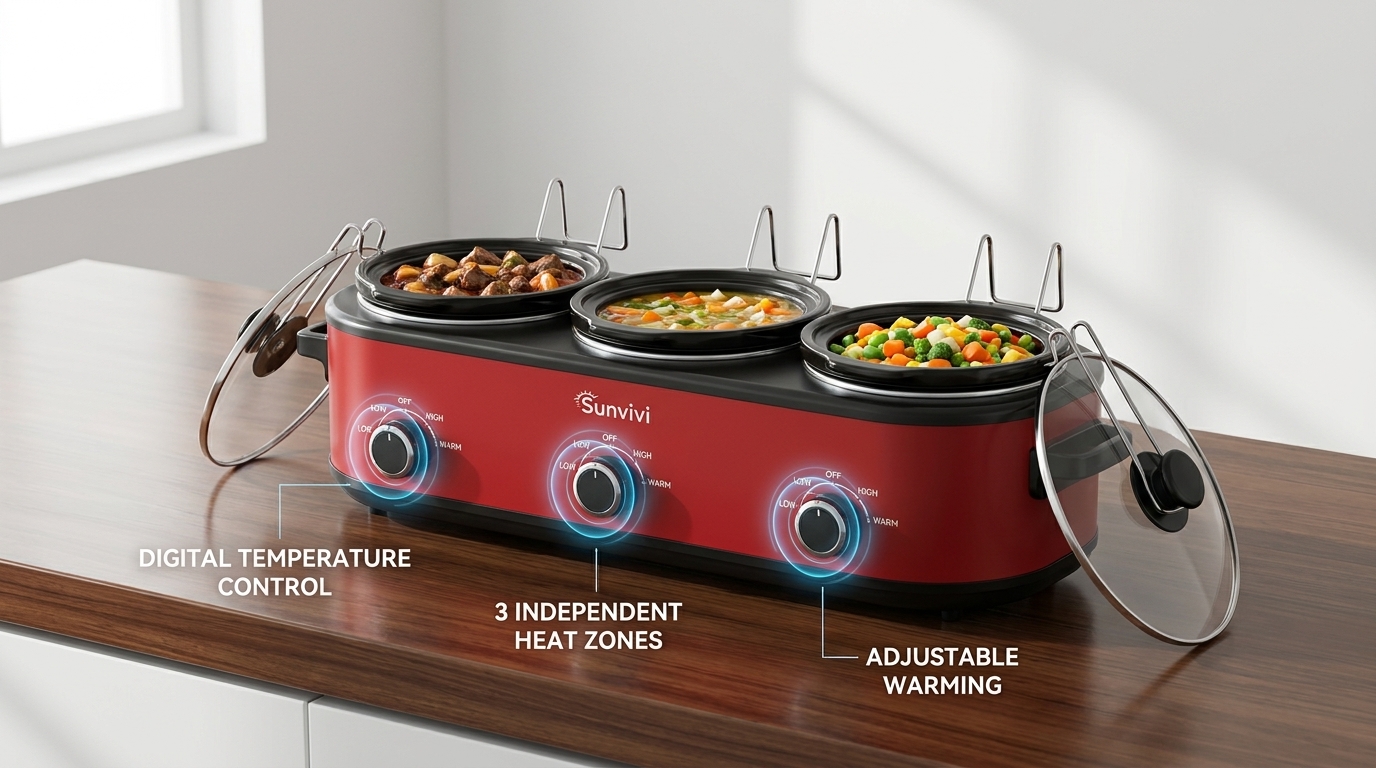
Anyone who has hosted a holiday dinner, a game-day gathering, or even a casual Sunday potluck knows the particular kind of stress that comes with keeping multiple dishes warm at the same time. One pot of chili sits cooling on the stove while the mashed potatoes go lukewarm in the oven, and by the time everyone’s plate is full, half the food has already lost its ideal temperature. This is the exact problem that triple slow cookers and buffet servers were designed to solve, and the Sunvivi Triple Slow Cooker Buffet Server and Warmer is one example of this category of kitchen appliance.
This particular model comes with three separate 1.5-quart ceramic pots, each with its own manual temperature dial, housed in a single stainless steel base. It’s built with entertaining in mind — think holiday buffets, potlucks, tailgates, and family-style dinners — but it can also serve more everyday functions, like slow-cooking three separate components of a meal or keeping side dishes at serving temperature during a long weeknight dinner. In this article, we’ll walk through what this appliance actually offers, how people commonly use tools like it, who tends to find it useful, and what’s worth thinking about before adding one to a kitchen. This is an informational guide rather than a review, and it doesn’t reflect firsthand testing — the goal here is simply to help you understand the product on its own terms so you can decide whether it fits your needs.
Key Features
Three Independent 1.5-Quart Ceramic Pots
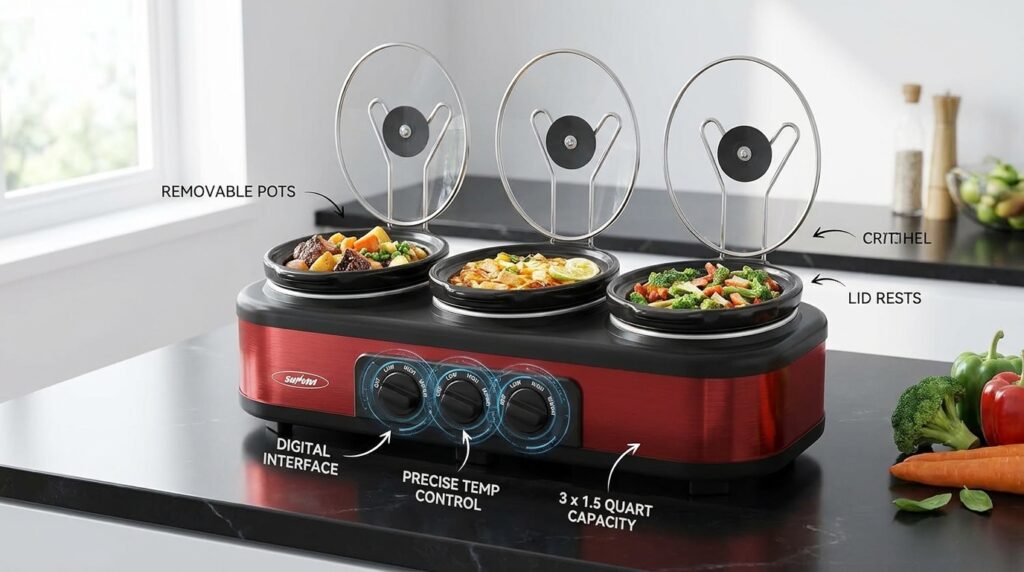
At the center of this appliance are three separate ceramic inserts, each with a 1.5-quart capacity, for a combined total of 4.5 quarts. Because the pots are ceramic rather than metal, they tend to distribute heat more evenly than thin metal inserts, which is part of why ceramic has remained a popular material for slow cooking in general. The pots are also described as removable, meaning they lift out of the stainless steel housing rather than being fixed in place — a detail that matters quite a bit when it comes to cleanup, which we’ll get to shortly.
Individually Adjustable Temperature Settings
Each of the three pots has its own heating element and its own manual dial, rather than a single shared control for the whole unit. In practical terms, this means you could have one pot on a “high” setting to actively cook something like rice or a stew, a second pot on “low” to gently finish a sauce, and a third on “warm” simply holding already-cooked food at serving temperature — all running at the same time, independently of one another. Based on the manufacturer’s listed specifications, the approximate temperature ranges are:
- High – around 100°C (212°F), suitable for active cooking
- Low – around 80°C (176°F), suitable for gentler, longer cooking
- Warm – around 60°C (140°F), intended for holding food at serving temperature rather than continuing to cook it
Because these are manual dial controls rather than a digital touchscreen or programmable timer, there’s no app connectivity or countdown display involved. You set the dial, and the unit maintains that setting until you change it or unplug it. Some people prefer this simplicity, since there’s nothing to sync or troubleshoot; others who are used to programmable cookers with auto-shutoff timers may find the manual approach requires a bit more attention.
Stainless Steel Lid Rests
One of the small but genuinely useful design details is the inclusion of stainless steel lid rests. If you’ve ever cooked with a lid-covered pot, you know the awkward moment of lifting the lid and having nowhere clean to set it down — it either drips onto the counter or gets balanced precariously against the pot itself. The lid rests here are built into the unit’s design specifically to hold the lids upright when they’re not in place, which helps keep the surrounding counter or buffet table tidier during use, especially when the unit is doing double duty as a serving station in front of guests.
Stainless Steel Housing and Base
The outer body of the unit is stainless steel, which tends to be more resistant to staining and scratching than plastic housings, and it generally wipes down easily with a damp cloth. This also gives the appliance a more polished look that fits reasonably well on a buffet table or countertop during entertaining, compared to a purely utilitarian plastic finish.
Compact, Party-Oriented Footprint
With three 1.5-quart pots side by side, this unit sits in a middle ground — larger than a single mini slow cooker, but noticeably smaller than a triple cooker built around three 2.5-quart or larger pots (which some competing models offer). This makes it reasonably easy to fit on a standard countertop, sideboard, or folding buffet table without dominating the space, though it’s still worth measuring your intended spot before purchasing, since “compact” is relative and three pots side by side does take up a meaningful stretch of counter.
Removable, Dishwasher-Friendly Pots
Because the ceramic inserts lift out of the base, they can generally be washed separately from the electrical housing, which should never be submerged in water. According to the product’s listed care information, the pots and lids are dishwasher-safe, while the base itself is meant to be wiped down rather than washed. This kind of separation between the “electrical” part and the “food contact” part is fairly standard for buffet-style slow cookers and tends to make cleanup considerably less tedious than appliances where everything is fused into one non-removable unit.
How It Can Be Used
While this appliance is marketed primarily around entertaining, its practical uses extend a bit further than just holiday buffets. Here are some of the more common ways a triple slow cooker like this one tends to get used.
Hosting Multi-Dish Gatherings
This is the most obvious use case, and probably the reason most people consider a triple slow cooker in the first place. Instead of juggling separate crockpots plugged into different outlets, or shuffling dishes in and out of a single oven, you can prepare three separate items — say, pulled pork, baked beans, and mac and cheese — and keep all three warm and ready to serve from one compact station. This is particularly handy for potlucks, holiday dinners, tailgates, or any gathering where food needs to stay accessible over a few hours rather than being served all at once.
Cooking Three Components of a Meal Simultaneously
Even outside of party settings, having three independently controlled pots opens up some interesting possibilities for everyday cooking. You could simmer a protein in one pot, a starch like rice or potatoes in a second, and a vegetable side in a third, all finishing around the same time without needing three separate cooking vessels on a stovetop. For households that regularly cook multi-component meals, this kind of parallel cooking can be a genuine time-saver, even on a random Tuesday.
Keeping Food at Serving Temperature for Extended Periods
The “warm” setting is specifically meant for holding already-cooked food rather than continuing to cook it, which makes this appliance useful as a straightforward food warmer — not just a cooker. This is particularly relevant for situations like open houses, drop-in gatherings, or buffet-style meals where guests arrive and eat at different times over the course of an afternoon or evening.
Small-Batch or Trial Cooking
Because each pot only holds 1.5 quarts, this unit also lends itself to smaller portions than a standard single 6-quart slow cooker. This can be useful for people cooking for one or two, for trying out a new recipe in a smaller batch before committing to a larger version, or for keeping three different sauce or dip options warm during a party — think a small queso, a marinara, and a barbecue sauce, each in its own pot.
Temperature-Sensitive Tasks
The listing notes that the temperature range extends into territory suitable for tasks like tempering chocolate or gently melting cheese, since the “low” and “warm” settings sit below a rolling boil. This kind of low, steady heat can be handy for fondue-style setups, warm dips, or dessert sauces that need gentle, consistent warmth rather than direct stovetop heat, which can scorch delicate ingredients if you’re not watching closely.
Who It May Be Suitable For
Given its size, design, and marketing angle, this type of appliance tends to appeal to a fairly specific set of households and use cases, though it’s worth being honest that it isn’t a universal fit for everyone.
People who host regularly. If holiday dinners, potlucks, or casual get-togethers are a recurring part of your routine, a triple buffet server can consolidate what would otherwise be several separate slow cookers or chafing dishes into one unit, which can simplify both setup and cleanup.
Smaller households. Because each pot is a modest 1.5 quarts, this unit is arguably better suited to smaller portions than to feeding a large crowd from a single pot. Someone cooking for one or two people, or a couple who likes to prep a few different small dishes rather than one large family-style meal, may find the capacity a good match.
People setting up a first kitchen. The listing itself points toward gifting occasions — college students, newlyweds, people moving into a first apartment — and this does track with how the appliance is built. It offers a fairly approachable, uncomplicated way to start cooking, without the learning curve of a more elaborate multi-function cooker.
Anyone who values simplicity over programmability. Since the controls are manual dials rather than digital timers, this appliance may suit people who prefer straightforward, tactile controls and don’t need programmable cook times or app integration.
On the other hand, this may be less suitable for people who regularly cook for large groups from a single dish, since 1.5 quarts per pot is a modest amount — more of a side-dish or small-main portion than something intended to feed a dozen people from one pot. It’s also probably not the ideal pick for someone who specifically wants a “set it and forget it” programmable cooker with an automatic shutoff timer, since the manual design requires the user to keep an eye on things and adjust settings by hand.
Important Things to Consider
No kitchen appliance is a perfect fit for every situation, and it’s worth thinking through a few practical details before deciding whether this one matches your needs.
Capacity Per Pot vs. Total Capacity
It’s easy to see “4.5 quarts total” and assume that’s comparable to a single mid-sized slow cooker, but the reality is a bit different. Because the capacity is split across three separate pots, each individual dish is limited to 1.5 quarts, which is roughly the size of a small standard slow cooker. If your goal is to make one large dish — like a big batch of chili for fifteen people — a triple cooker with smaller individual pots probably isn’t the most efficient tool for that specific job. It really shines when the goal is variety (three different dishes) rather than volume (one enormous dish).
Manual vs. Digital Controls
Since this is a manual unit, there’s no programmable timer or automatic shutoff based on cook time. That means it’s worth staying reasonably attentive while it’s running, particularly on the “high” setting, the same way you would with a traditional slow cooker that lacks a smart timer. Some people find this simplicity reassuring, while others who are used to walking away from a programmed appliance for eight hours might need to adjust their habits slightly.
Countertop and Storage Space
Three pots arranged side by side, even at a modest 1.5 quarts each, still add up to a piece of equipment with a reasonably wide footprint. It’s worth measuring your available counter space, buffet table, or storage cabinet before buying, especially in smaller kitchens where appliance storage is already at a premium.
Ceramic Pot Care
Ceramic inserts, while generally durable and good at even heat distribution, can be more prone to cracking or chipping from sudden temperature changes than metal ones — for instance, moving a pot straight from the refrigerator into a hot base, or rinsing a hot pot in cold water. Letting pots come closer to room temperature before drastic temperature shifts is a reasonable habit with most ceramic cookware, this one included.
Electrical Safety Basics
As with any electric countertop appliance, the stainless steel base that houses the heating elements should never be submerged in water or placed in a dishwasher — only the removable ceramic pots and lids are described as dishwasher-safe. Keeping the cord and base away from water during cleaning is a standard precaution worth keeping in mind.
Color and Variant Options
This particular listing is for the red version with 1.5-quart pots, but Sunvivi and similar brands often produce this general style of buffet server in multiple colors and sometimes slightly different pot sizes (for example, some versions ship with 1.5-quart round pots while others use oval crocks, or come in black, grey, or blue). If a specific finish or capacity matters to you, it’s worth double-checking the exact listing details before purchasing, since appliance lines like this are frequently updated or offered in parallel variants.
Comparison of General Categories
Rather than comparing this specific product to any single named competitor, it’s useful to understand where triple buffet servers fit within the broader landscape of slow-cooking and food-warming appliances.
Single slow cookers are the most familiar version of this category — one pot, one lid, one heat setting, typically in a 4- to 8-quart range. They’re well suited to cooking one large dish over several hours and are often the more space-efficient choice if you only need to prepare a single item at a time. What they don’t offer is the ability to run multiple dishes at different temperatures simultaneously, which is the core advantage of a triple-pot design.
Dual (two-pot) buffet servers split the difference — they offer some of the “multiple dish” flexibility of a triple cooker while taking up less space than a three-pot unit. These can be a reasonable middle ground for smaller gatherings or households that don’t need three separate dishes running at once.
Triple buffet servers and food warmers, the category this product belongs to, are built specifically around the idea of running three dishes independently, whether that means three different foods, three different temperatures for the same type of dish, or a mix of active cooking and simple holding. The tradeoff is generally counter space and, in many cases, smaller per-pot capacity compared to a standalone slow cooker, since three pots have to share a single base.
Chafing dishes, by contrast, typically rely on fuel (like sterno cans) rather than electricity, and are generally designed purely for holding already-cooked food warm rather than cooking from raw ingredients. They’re common at catered events and larger buffets, but they don’t offer the active cooking function that an electric slow cooker–style buffet server does.
Digital or programmable slow cookers, whether single or multi-pot, add features like cook-time countdowns and automatic shutoff to “warm” mode once cooking finishes. This can be convenient for hands-off cooking, but it also adds complexity and, often, cost, compared to a manually controlled model.
None of these categories is strictly better than another — they’re built around different priorities, whether that’s total capacity, hands-off convenience, portability, or the ability to run multiple dishes side by side. Where a triple manual buffet server like this one tends to land is somewhere between a simple single-pot slow cooker and a more elaborate catering setup: enough flexibility to handle a handful of dishes for a moderate group, without the scale or cost of commercial buffet equipment.
Frequently Asked Questions
Can each pot be used at a different temperature at the same time? Yes, based on the product’s design, each of the three pots has its own heating element and manual dial, so they can be set independently — for example, one on high, one on low, and one on warm, all running simultaneously.
Are the pots removable, and can they go in the dishwasher? The ceramic pots and lids are described as removable and dishwasher-safe. The stainless steel base housing the heating elements is not meant to be submerged in water and should instead be wiped clean with a damp cloth.
Is this a digital or programmable slow cooker? No. This model uses manual dial controls for each pot rather than a digital display or programmable timer, so it requires manual adjustment rather than an auto-shutoff or countdown function.
How much food does each pot hold? Each of the three pots has a 1.5-quart capacity, for a combined total of 4.5 quarts across all three. This tends to suit side dishes, dips, or smaller portions rather than one very large single dish.
Can it be used for everyday cooking, not just parties? While it’s marketed toward entertaining and buffet-style serving, there’s nothing stopping it from being used for regular meal prep — for instance, cooking three separate components of a weeknight dinner, or keeping small batches of food warm for a household that eats at staggered times.
What temperature range does it offer? According to the manufacturer’s listed specifications, the settings run roughly from about 140°F on “warm” up to around 212°F on “high,” with “low” sitting in between at roughly 176°F. These are approximate figures intended to guide expectations rather than exact guarantees, since appliance performance can vary somewhat by unit.
Does it come with serving spoons or other accessories? Accessory inclusions can vary by listing and by retailer, so it’s worth checking the specific product page for the most current and accurate information on what’s included in the box.
What colors or capacity options are available? This particular listing is for the red 3 x 1.5-quart version, though the broader product line has historically included other colors and, in some cases, different pot shapes or sizes. If a specific variant matters to you, confirming the exact listing details before ordering is a sensible step.
Conclusion
The Sunvivi Triple Slow Cooker Buffet Server and Warmer occupies a fairly specific niche: it’s not trying to replace a large single slow cooker meant for feeding a crowd from one pot, and it’s not a commercial-grade buffet setup either. Instead, it’s built around the idea of running three smaller, independently controlled dishes at once, which makes it a reasonably practical option for people who host smaller gatherings, want to prepare a few different sides or dips simultaneously, or simply like the flexibility of having three separate temperature zones on one countertop appliance. The manual controls keep things simple, the removable ceramic pots make cleanup more manageable, and the compact three-pot layout is a sensible middle ground between a single slow cooker and larger multi-pot catering equipment.
VIEW ON AMAZON